Gulf States Retreat From Thermal Desalination as Brine Chokes the Sea
Gulf States Retreat From Thermal Desalination as Brine Chokes the Sea
The Quiet Retreat From Thermal Desalination
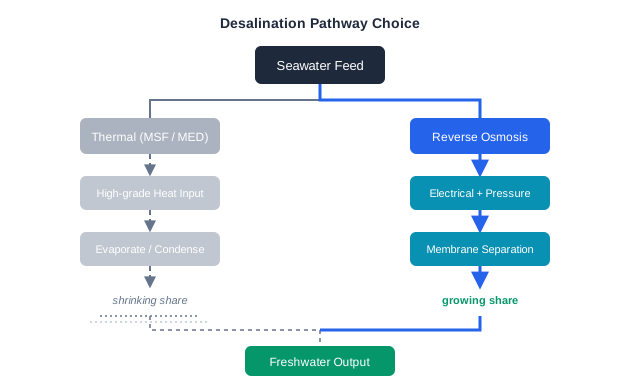
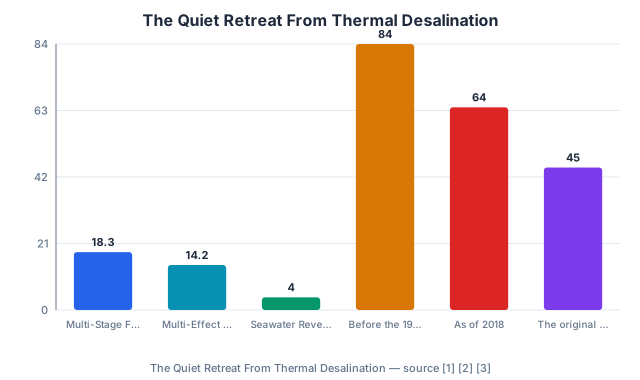
As of 2018, 64% of Saudi Arabia’s desalinated water came from Multi-Stage Flash (MSF) distillation — a technology that consumes 18.3–28.5 kWh per cubic metre of product water (a separate estimate puts MSF as low as 12.5–24 kWh/m³ [8]), up to seven times — comparing MSF’s high end against SWRO’s low end — what modern Seawater Reverse Osmosis (SWRO) requires at 4–6 kWh/m³ [2][1]. The remainder split between RO (20%) and Multi-Effect Distillation (MED, 16%, 14.2–21.6 kWh/m³) [2][1]. This thermal dominance is a legacy: before the 1980s, MSF and MED together produced roughly 84.0% of the world’s desalinated water, [1]. That legacy is now being dismantled asset by asset. ACWA Power and Saudi Water Partnership Company have agreed to reconfigure the Shuaibah 3 Independent Water and Power Project — originally a thermal water-and-power facility — into a greenfield SWRO plant, with thermal shutdown in 2025 [3]. The conversion is projected to save 45 million tons of CO₂ and 22 million barrels of crude oil annually — figures that do not reconcile arithmetically as reported, marking the first thermal plant wholly replaced by RO that utilizes renewable energy and cutting energy consumption by up to 70% [3][4]. The replacement carries real scale: a 25-year, roughly SAR 3 billion water purchase agreement for 600,000 m³/day of new SWRO capacity, signed with a consortium led by ACWA Power and PIF-owned Badeel [4]. Dubai’s utility, DEWA, is pursuing the same model, targeting 730 MIGD of total desalination capacity by 2030 with a 100% clean-energy mix, combining renewable energy and waste heat [6]. Shuaibah 3 and DEWA’s roadmap suggest thermal retreat may be an emerging regional pattern, though two projects fall short of confirming a region-wide default.
A Sea Getting Saltier: The Brine Feedback Loop
That energy penalty is only half the cost of desalinating a hypersaline sea — the other half is discharged straight back into it. The Middle East now produces 52.83 million m³/day of desalination brine, just over half the world’s total [1], with Saudi Arabia (18.14 million m³/day), the UAE (13.82 million m³/day), and Qatar (4.46 million m³/day) the largest single contributors [1]. The math is unforgiving: regional plants average only about a 25% recovery ratio, so three-quarters of every cubic meter of seawater drawn returns to the sea as concentrate [1]. With sea disposal the dominant outlet, nearly all lands back in the same shallow, semi-enclosed basin the intakes draw from.
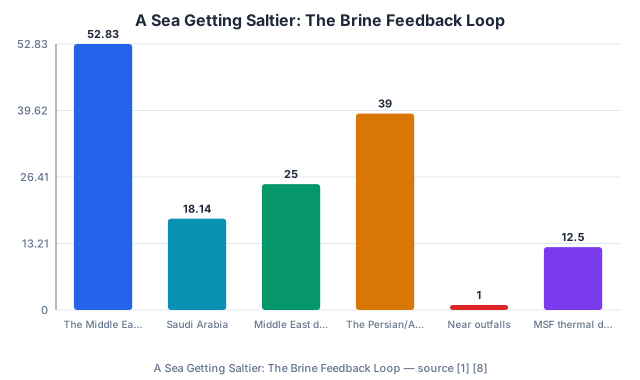
That basin has little room to absorb it. The Gulf averages 39 psu [8], so brine loading compounds an already-saline baseline. The ecological threshold is tight: a localized 1–2 ppt rise above ambient near an outfall significantly harms Posidonia oceanica seagrass [8]. Basin-scale modeling put 2022 output at 22.6 million m³/day (2.3% of evaporation flux), rising to 39.5 million m³/day (4%) by 2030 and 80 million m³/day by 2050 [9]. At a modeled ceiling of 120 million m³/day under present-day climate conditions, inshore salinity could rise 0.4 psu; worst-case scenarios with reduced Strait of Hormuz outflow show 1+ psu [9]. The most likely basin-wide outcome—0.5 psu, within seasonal variability—is buffered by Strait exchange [9]. That buffer, however, feeds back into cost: higher-salinity intake (36,000 ppm Oman Sea water vs. 17,000 ppm Caspian water) raised annual high-pressure pump energy costs from $3,553,910 to $4,928,163 in one modeled 200,000 m³/day RO plant [10]. Regionally, the response has lagged the risk: legal commentary on the 1990 ROPME Protocol characterizes it as flagging desalination discharge as a priority effluent requiring regional standards, and finds that, decades on, no such standard exists, leaving Gulf states to regulate brine independently with no shared benchmarks [11].
The Subsidy Math Behind Cheap Water
Those record-low production costs don’t reach consumers unfiltered — across the Gulf, subsidies sit between plant gate and tap. GCC countries—Saudi Arabia, UAE, Kuwait, Bahrain—heavily subsidize desalination, distorting cost signals to consumers and slowing efficiency adoption [1]. Saudi Arabia is estimated to burn approximately 300,000 barrels of oil per day to power its desalination sector, per one secondary estimate of unconfirmed currency [12], even as the kingdom’s Water Authority reports the underlying cost of desalinating one cubic meter of seawater has fallen to roughly SAR 1.7, with power consumption dropping from 15 kWh to 2.3 kWh over the past decade — a figure below both the 4–6 kWh/m³ SWRO floor and the 2.8 kWh/m³ achieved by the Jubail 3A plant profiled later in this piece, and worth treating cautiously, given it comes from a single trade-press report [15]. The scale of investment underscores the stakes: Middle Eastern countries spent approximately $53.4 billion in capital expenditure and $49.3 billion in operational costs on desalination infrastructure between 2006 and 2024 [1], and Saudi Arabia planned a further $80 billion over the following decade as of 2020 [12].
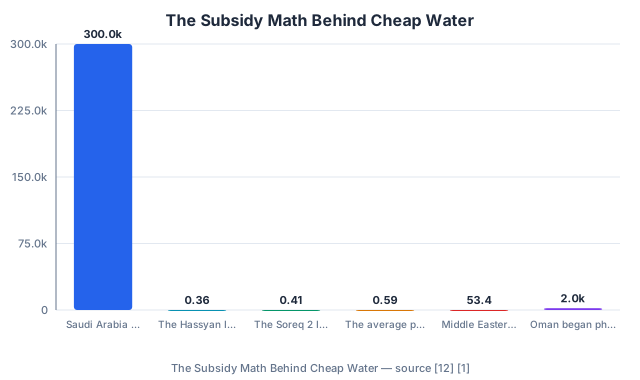
The mismatch between subsidized price and actual cost is stark in Abu Dhabi, where the true cost of supplying residential water—production, transmission, distribution—was AED 10.62 per 1,000 litres in 2014 [13], while subsidies and transfers cost the government about $13 billion annually, roughly 20% of its budget [13]. Reform has been uneven. Abu Dhabi raised expatriate water tariffs 170% from January 2015 (AED 2.2 to AED 5.95 per 1,000 litres), while Emirati nationals shifted from free to AED 1.7 per 1,000 litres for usage up to 700 litres daily [13]. Saudi Arabia took a narrower approach, raising industrial water tariffs from SR 4 to SR 9 per cubic metre in December 2015 while shielding residential consumers entirely [14]. Oman began phasing out water and electricity subsidies in 2021 to encourage efficient use [1]. The result is visible in consumption: GCC per capita water use—560 litres daily—is roughly three times the global average [12].
Chasing the Sun: Solar-Coupled RO at Scale
Beyond individual efficiency gains, the region’s newest plants are increasingly built to run on sunlight rather than gas. ACWA Power’s $650m Jubail 3A (Jazlah) plant produces 600,000 m³/day and stands as Saudi Arabia’s first integrated desalination and solar PV facility [16]. Its 45.5MW solar PV array supplies 20% of the plant’s energy consumption [16], achieving a specific energy consumption of 2.8 kWh/m³ on Arabian Gulf seawater — itself below the 4–6 kWh/m³ SWRO floor cited elsewhere in this piece — and a water tariff of 1.54 SAR/m³ [16]. Nearby, ACWA Power’s Rabigh 3 IWP—also a 600,000 m³/day SWRO plant serving the Makkah region—has maintained above 99% availability as of its January 2026 refinancing [17].
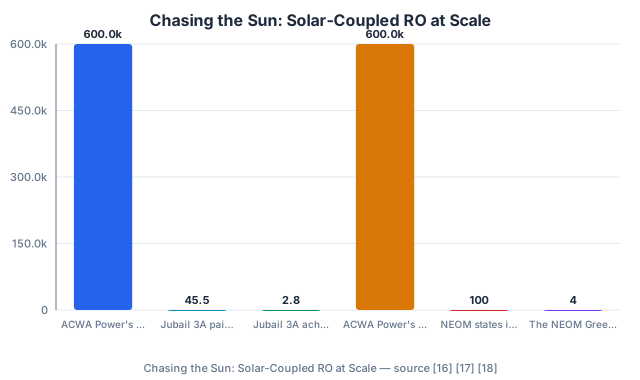
NEOM is pushing the model further, committing to desalinated water produced entirely from renewable energy, drawing on both solar and complementary wind resources [18]. A feasibility study explores high-recovery RO paired with zero liquid discharge (ZLD) to eliminate brine altogether [18]. This renewable capacity overlaps with NEOM’s Green Hydrogen Project, which integrates over 4GW of solar, wind, and storage to power electrolysis for 650 tonnes/day of hydrogen, targeted for 2025 — a date that has since passed with no confirmed updated status [18].
The economics of this pairing are substantial. A KAUST-authored NEOM study found that co-optimizing power and desalination investment cut levelized electricity costs 7% in PV-only scenarios ($47.90 to $44.57/MWh) and 3.8% in wind-only scenarios ($134.07 to $128.92/MWh), with total power-sector costs falling 10.9% (wind) versus 6.0% (PV) [19]. Jordan’s Aqaba-Amman project illustrates variability’s cost: full-load RO with 46% PV costs about $1.8/m³, but following the PV profile directly pushes cost to $2.5/m³, with each additional 1% of PV share up to 72% adding roughly $0.02/m³ [20].
A Single Point of Failure: The Membrane Supply Chain
Behind the shift to RO lies a critical dependency: in the UAE, the membranes themselves are almost entirely imported. The UAE has no local manufacturing of reverse osmosis membranes, high-pressure pumps, or electronic controls; membranes are almost entirely imported, with 80%+ of control systems from Europe, the US, and East Asia [22]. The global RO membrane market is only moderately concentrated, dominated by five firms—Toray Industries, Nitto Denko (Hydranautics), LG Chem, Koch Membrane Systems, and DuPont—with manufacturing weighted toward Asia-Pacific, which captured 45.60% of global revenue in 2025, concentrated in China’s Jiangsu and Zhejiang provinces [23].
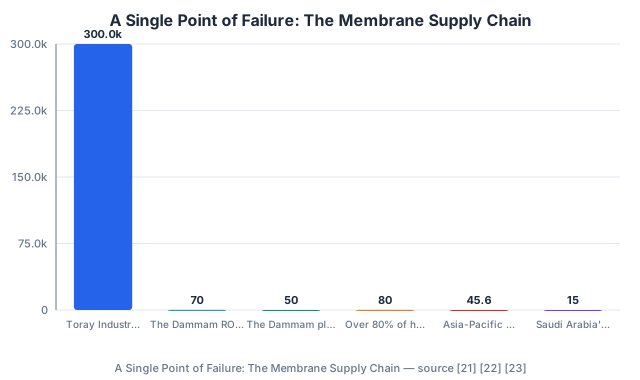
Gulf demand strains this supply chain directly: Saudi Arabia’s NEOM giga-project alone would require membrane volumes equal to roughly 15% of current annual global production, per one market-research vendor’s estimate [23]. Saudi Arabia is localizing capacity—Toray and Abunayyan Holding’s joint-venture plant in Dammam’s Third Industrial City, backed by an investment exceeding SAR 1 billion, produces 300,000 membranes annually across six integrated production lines, targets around 70% Saudization and local content, and aims to cut regional supply-chain lead times by over 50% while improving energy consumption by 4–5% [21]. The stakes are critical: thermal desalination still accounts for roughly 70% of GCC capacity even as Saudi Arabia’s Saline Water Conversion Corporation pivots toward RO [24], and national water security is already deeply tied to desalination—42% of UAE drinking water, 90% in Kuwait, 86% in Oman, and 70% in Saudi Arabia [25]. Yet SWRO membranes could be markedly more vulnerable to fouling than the thermal plants they replace [7], meaning supply disruption now threatens wholly imported, mission-critical infrastructure.
The Reform Gulf States Keep Avoiding
GCC per capita water use exceeds 500 litres daily—more than four times Germany’s 120-litre benchmark (a different comparator than the global-average figure cited earlier) [26]. Desalination has made that possible without cost discipline: production fell from roughly $5.00/m³ (1980s) to as low as $0.40–0.50/m³ in recent projects, yet retail prices remain subsidized [26]. The region produces nearly half the world’s desalinated water on less than 1% of its population [26], holds 46.9% of contracted and 41.8% of operational global capacity, and generates 50.68% of global brine at just 25% recovery [1].
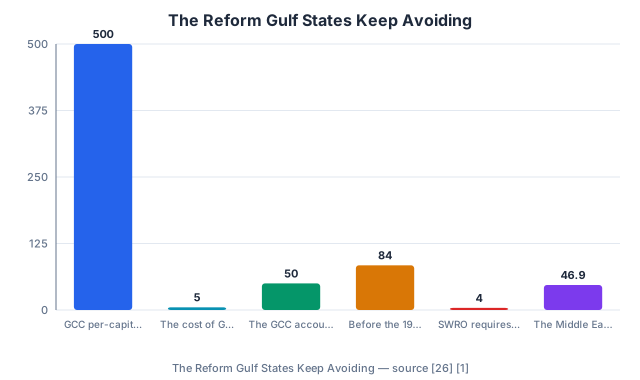
The efficiency gains are real: the shift from thermal MSF (18.3–28.5 kWh/m³) and MED (14.2–21.6 kWh/m³)—which together once produced 84% of global desalinated water—to SWRO at 4–6 kWh/m³ has substantially cut energy consumption [1][1]. The Gulf basin itself appears able to absorb the buildout: current desalination output equals roughly 2% of net yearly evaporation, rising to a projected 8% by 2050, with modeled basin-scale salinity increases staying below 1 psu even in worst-case scenarios [27]. The environmental ceiling, in other words, is not the binding constraint.
Demand management is. Saudi Arabia’s National Water Strategy 2030 reportedly targets cutting per-capita consumption from 256 to 200 litres daily and raising tariff cost-recovery from 30% to 100%, per secondary reporting rather than the official strategy document—against current consumption still above 250 litres daily [32][33]. Israel, by contrast, already prices water close to cost: household tariffs are likely to rise 4.44% in 2025 (NIS 7.39 to NIS 7.71/m³), tracking electricity and plant-operating costs directly rather than subsidies [31]—a system alongside which desalination has scaled from roughly 40% of national supply around Sorek’s 2013 launch to a projected 70–80% of drinking-water needs by the mid-2020s [29][30]. The Gulf has proven it can build desalination capacity and drive down unit cost; what it has not done is pass that cost signal to consumers. Whether GCC states follow Saudi Arabia’s tariff-reform trajectory—or continue subsidizing demand that cheap desalinated water makes easy to ignore—will determine whether the region’s water security rests on efficient supply alone or on supply plus restraint.
References
- Desalination and the Middle East: research, practices, implications, and prospects — npj Clean Water (Khanzada, Al-Juboori, Ibrahim, Khatri, Ahmed, An, Hilal; Jan 12, 2026) — nature.com — https://www.nature.com/articles/s41545-026-00554-x
- Water in Saudi Arabia: Desalination, Wastewater, and Privatization — US-Saudi Business Council — ussaudi.org — https://ussaudi.org/water-in-saudi-arabia-desalination-wastewater-and-privatization/
- ACWA Power and Saudi Water Partnership Company to reconfigure Shuaibah 3 — ACWA Power newsroom — acwapower.com — https://www.acwapower.com/news/acwa-power-and-saudi-water-partnership-company-to-reconfigure-shuaibah-3-from-an-energy-intensive-water-and-power-facility-to-a-greenfield-reverse-osmosis-plant/
- ACWA Power, SWPC and SWEC partner to upgrade Shuaibah 3 IWPP — NS Energy — nsenergybusiness.com — https://www.nsenergybusiness.com/news/acwa-power-swpc-swec-shuaibah-3-iwpp/
- DEWA selects Preferred Bidder for Phase 1 - 180 MIGD Hassyan Seawater Reverse Osmosis using the IWP model — Zawya — zawya.com — https://www.zawya.com/en/press-release/government-news/dewa-selects-preferred-bidder-for-phase-1-180-migd-hassyan-seawater-reverse-osmosis-using-the-iwp-model-cb8rdsv1
- DEWA’s Adoption Of Sea Water Reverse Osmosis For Water Desalination Using Clean Energy — Water Online — wateronline.com — https://www.wateronline.com/doc/dewa-s-adoption-of-sea-water-reverse-osmosis-for-water-desalination-using-clean-energy-enhances-efficiency-climate-action-0001
- Could Iran Disrupt the Gulf Countries’ Desalinated Water Supplies? — CSIS (David Michel, March 19, 2026) — csis.org — https://www.csis.org/analysis/could-iran-disrupt-gulf-countries-desalinated-water-supplies
- Characteristics of Desalination Brine and Its Impacts on Marine Chemistry and Health, With Emphasis on the Persian/Arabian Gulf: A Review — Frontiers in Marine Science — frontiersin.org — https://www.frontiersin.org/journals/marine-science/articles/10.3389/fmars.2022.845113/full
- Long-term, basin-scale salinity impacts from desalination in the Arabian/Persian Gulf — Scientific Reports — nature.com — https://www.nature.com/articles/s41598-022-25167-5
- Evaluation for the optimization of two conceptual 200,000 m3/day capacity RO desalination plant with different intake seawater of Oman Sea and Caspian Sea — PMC — pmc.ncbi.nlm.nih.gov — https://pmc.ncbi.nlm.nih.gov/articles/PMC7807410/
- A Gulf Between Law and Practice? Marine Environment Protection and Desalination Discharges in the Persian Gulf — EJIL:Talk! — ejiltalk.org — https://www.ejiltalk.org/a-gulf-between-the-law-and-practice-marine-environment-protection-and-desalination-discharges-in-the-persian-gulf/
- The Costs and Benefits of Water Desalination in the Gulf — arabcenterdc.org — https://arabcenterdc.org/resource/the-costs-and-benefits-of-water-desalination-in-the-gulf/
- A brave move by Abu Dhabi on water tariffs (MEED) — meed.com — https://www.meed.com/a-brave-move-by-abu-dhabi-on-water-tariffs/
- Saudi Arabia to raise water tariff (MEED) — meed.com — https://www.meed.com/saudi-arabia-to-raise-water-tariff/
- Saudi Arabia Cuts Desalination Costs to SAR 1.7 per Cubic Meter (Desalination News) — desalination-news.com — https://www.desalination-news.com/2025/12/12/saudi-arabia-cuts-desalination-costs-to-sar-1-7-per-cubic-meter/
- ACWA Power opens Saudi Arabia’s first solar-powered desalination plant — nsenergybusiness.com — https://www.nsenergybusiness.com/company-news/acwa-power-solar-powered-desalination-plant/
- ACWA Power Completes Refinancing of Rabigh 3 Desalination Plant — solarquarter.com — https://solarquarter.com/2026/01/02/acwa-power-completes-refinancing-of-rabigh-3-desalination-plant-strengthening-saudi-arabias-sustainable-infrastructure-goals/
- NEOM: pioneering green hydrogen and internet of water (IoW) — aquatechtrade.com — https://www.aquatechtrade.com/news/desalination/neom-pioneering-green-hydrogen-and-clean-water
- Simulated co-optimization of renewable energy and desalination systems in Neom, Saudi Arabia (Nature Communications) — pmc.ncbi.nlm.nih.gov — https://pmc.ncbi.nlm.nih.gov/articles/PMC9206678/
- Powering seawater desalination plants with photovoltaics — pv-magazine.com — https://www.pv-magazine.com/2025/02/13/powering-seawater-desalination-plants-with-photovoltaics/
- Middle East’s Largest Water Desalination Membrane Plant Opens in KSA — scenenow.com — https://scenenow.com/News/Middle-East-s-Largest-Water-Desalination-Membrane-Plant-Opens-in-KSA
- Water Treatment and Desalination Systems Market in the United Arab Emirates (IndexBox) — indexbox.io — https://www.indexbox.io/store/united-arab-emirates-water-treatment-and-desalination-systems-market-analysis-forecast-size-trends-and-insights/
- Reverse Osmosis Membrane Market Size & Share Analysis (Mordor Intelligence) — mordorintelligence.com — https://www.mordorintelligence.com/industry-reports/reverse-osmosis-membrane-market
- Saudi Arabia - Water (International Trade Administration, U.S. Dept. of Commerce) — trade.gov — https://www.trade.gov/country-commercial-guides/saudi-arabia-water
- The Geopolitics of Seawater Desalination (Policy Center for the New South / Ifri) — policycenter.ma — https://www.policycenter.ma/publications/geopolitics-seawater-desalination
- From Scarcity to Sustainability: The GCC’s Journey Towards Water Security — World Bank — worldbank.org — https://www.worldbank.org/en/news/opinion/2024/03/26/from-scarcity-to-sustainability-the-gcc-s-journey-towards-water-security
- Long-term, basin-scale salinity impacts from desalination in the Arabian/Persian Gulf — Scientific Reports (Nature) — pmc.ncbi.nlm.nih.gov — https://pmc.ncbi.nlm.nih.gov/articles/PMC9709068/
- Sorek I Desalination Plant (Israel) — IDE Tech — ide-tech.com — https://ide-tech.com/en/project/sorek-desalination-plant/
- Megascale Desalination — MIT Technology Review — technologyreview.com — https://www.technologyreview.com/technology/megascale-desalination/
- Facing drought, Israel to direct desalinated water to Sea of Galilee, in world first — Times of Israel — timesofisrael.com — https://www.timesofisrael.com/facing-drought-israel-to-direct-desalinated-water-to-sea-of-galilee-in-world-first/
- Water rates likely to rise 4.4% in Israel in July — Globes — en.globes.co.il — https://en.globes.co.il/en/article-water-rates-likely-to-rise-44-in-israel-in-july-1001371836
- Drivers and Challenges to Water Tariff Reform in Saudi Arabia — Queen’s University Belfast (academic repository) — pureadmin.qub.ac.uk — https://pureadmin.qub.ac.uk/ws/files/205158712/Drivers_and_Challenges_to_Water_Tariff_Reform_in_Saudi_Arabia.pdf
- Water Consumption in Saudi Arabia — Vision 2030 encyclopedia — vision2030.ai — https://vision2030.ai/encyclopedia/saudi-arabia-water-consumption/