EPA’s 2024 PFAS Limits and the Utility Compliance Squeeze
EPA’s 2024 PFAS Limits and the Utility Compliance Squeeze
The Deadline Nobody Asked For
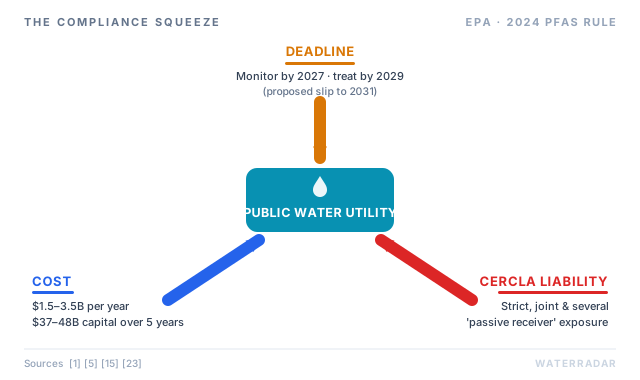
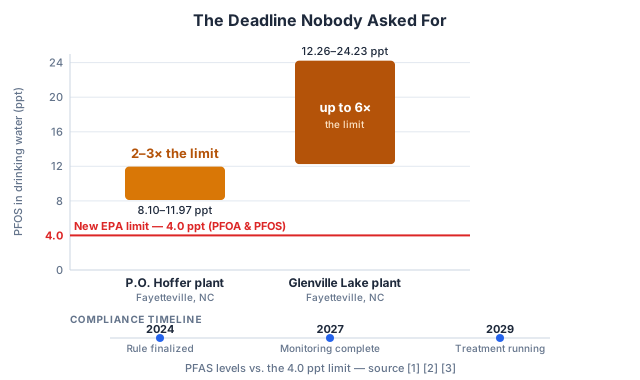
Fayetteville, North Carolina’s P.O. Hoffer treatment plant has been running PFOS levels between 8.10 and 11.97 ppt since January 2021 — two to three times the limit it now has to meet [3]. Its Glenville Lake plant fares worse, averaging 12.26 to 24.23 ppt over the same span, up to six times over [3]. On April 10, 2024, EPA finalized the first legally enforceable federal limits on PFAS in drinking water: 4.0 ppt for PFOA and 4.0 ppt for PFOS individually, plus a Hazard Index MCL of 1 for mixtures of PFHxS, PFNA, HFPO-DA, and PFBS, with those three capped individually at 10 ppt [1]. Utilities get three years to finish initial monitoring, by 2027, and five years to have treatment running, by 2029 [1]. EPA estimates 6% to 10% of the roughly 66,000 public water systems covered by the rule will need new treatment, source water, or blending to comply [2]. Fayetteville PWC’s answer is an $80 million filtration system, partly covered by an $11.5 million grant and a $19 million low-interest loan, targeted online by February 2028 — a year ahead of the federal deadline [3]. The Association of Metropolitan Water Agencies calls the rule a multi-billion-dollar unfunded mandate that ratepayers will ultimately cover [4], and the American Water Works Association puts the national tab for PFOA/PFOS treatment above $3.8 billion a year [5]. Three months later, EPA added a second obligation: PFOA and PFOS became CERCLA hazardous substances on July 8, 2024 [6].
Picking a Weapon: GAC, Ion Exchange, or Reverse Osmosis
Meeting EPA’s limits is only the compliance floor — the harder question is which of three technologies a utility deploys to get there, since each carries distinct cost, footprint, and waste-disposal tradeoffs [1].
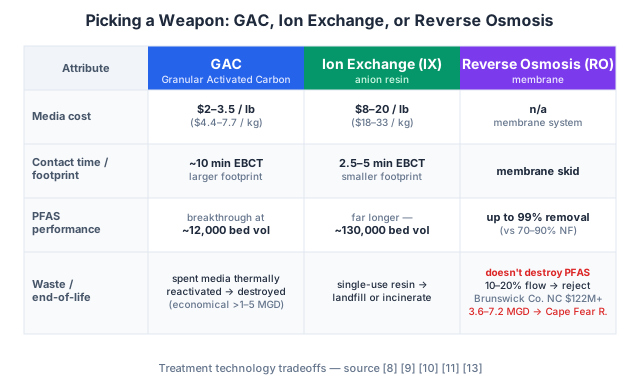
Granular activated carbon (GAC) is the cheapest media on a per-pound basis, at roughly $4.4-$7.7/kg ($2.0-$3.5/lb) versus $18-$33/kg ($8-$20/lb) for anion exchange resin [11], and a separate vendor comparison puts GAC near $2/lb against $4-$12/lb for ion-exchange resins [13]. But GAC needs a longer empty bed contact time — about 10 minutes per vessel versus 2.5 to 5 minutes for ion exchange — meaning a larger equipment footprint and more frequent media replacement, which partially erodes its cost edge [13]. Cape Fear Public Utility Authority’s Sweeney plant illustrates the scale required: nearly 3 million pounds of GAC, a $35.9 million construction contract, and operating costs of $3.7 million in FY2023 rising to at least $5 million annually thereafter [8]. GAC’s advantage is destruction: spent media can be thermally reactivated and returned to service, though that’s only economical at plants above roughly 1-5 MGD [11].
Ion exchange (IX) resists breakthrough far longer — Eau Claire, WI saw none after 130,000 bed volumes, versus GAC breaking through around 12,000 bed volumes in high-organic-carbon source water, which pushed that utility to switch technologies entirely [13]. But single-use IX resin isn’t reactivated; it’s landfilled or incinerated along with its adsorbed PFAS [11].
Reverse osmosis (RO) removes up to 99% of PFAS versus 70-90% for nanofiltration [13], but Brunswick County, NC’s $122+ million RO plant discharges 3.6-7.2 million gallons per day of GenX-concentrated wastewater back into the Cape Fear River [9][10] — RO separates PFAS but doesn’t destroy it, merely detouring 10-20% of throughput as concentrate back to the source [10].
The Bill: Who Actually Pays for Compliance
Treatment technology exists — the harder question is who funds it. EPA pegs annual compliance cost at roughly $1.5 billion [14], but AWWA’s analysis, drawn from UCMR 5 occurrence data, puts the figure at $2.7 to $3.5 billion annually — roughly double EPA’s number [15]. A Black & Veatch analysis cited by the National League of Cities lands in between, estimating $2.5 to $3.2 billion annually and a 3-4% increase in national water spending [14]. AWWA has formally challenged EPA’s cost analysis as not reflective of the best available or nationally representative occurrence data [15], and GAO has confirmed that dispute is active in litigation, noting its own review only checked EPA’s procedural compliance, not the accuracy of the estimates [16].
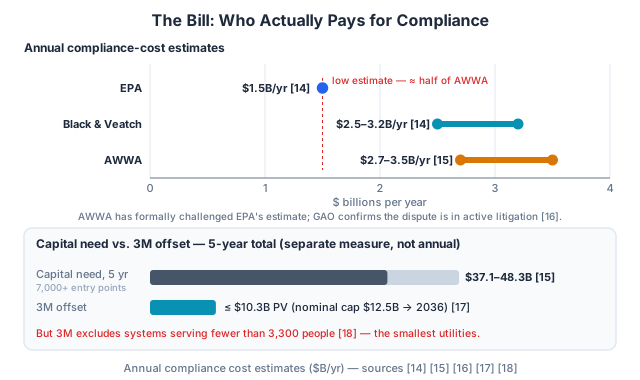
The capital side is starker: AWWA projects more than 7,000 water system entry points will require capital investment over the next five years, totaling $37.1 to $48.3 billion [15]. Some of that will be offset by PFAS manufacturer settlements — 3M’s nominal cap runs to $12.5 billion (present value up to $10.3 billion) paid out through 2036, front-loaded with $2.9 billion in 2024 and $1.8 billion in 2025 [17] — but 3M excludes systems serving fewer than 3,300 people, unlike DuPont’s settlement [18], and payouts are allocated per source using a PFAS Score and Adjusted Flow Rate rather than evenly [19]. That structural gap shows in adoption: just 7% of systems serving under 500 people have installed advanced filtration, versus 28% of the largest utilities [20]. Cape Fear Public Utility Authority financed $43 million in bonds for its Sweeney plant upgrade, with O&M costs climbing from $3.7 million to at least $5 million annually [13] — a scale few small systems can replicate, and AMWA’s Dan Hartnett calls cost "certainly the largest challenge" for smaller utilities [20].
The Liability Trap: CERCLA and the "Passive Receiver" Defense
Compliance costs are only half the exposure — the other half arrives through Superfund. On April 17, 2024, EPA designated PFOA and PFOS (including their salts and structural isomers) as hazardous substances under CERCLA Section 102(a), effective July 8, 2024, triggering strict, joint-and-several liability [23]. EPA set a default reportable quantity of one pound per 24 hours for PFOA or PFOS releases, below which release reporting is not required [23]. Under CERCLA’s strict, joint-and-several scheme, cost recovery and enforcement can reach any potentially responsible party — past and present owners and operators of contaminated properties, transporters, and arrangers — not just the original manufacturer [29].
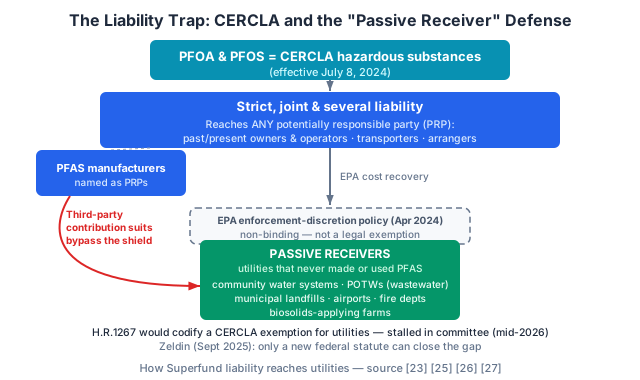
Utilities that never manufactured or intentionally used PFAS are nonetheless "passive receivers": drinking water suppliers with PFAS-impacted source water, wastewater plants receiving contaminated influent, and disposal facilities accepting PFAS-laden waste [24]. EPA’s April 2024 enforcement discretion policy states it does not intend to pursue community water systems, POTWs, municipal landfills, airports, fire departments, or biosolids-applying farms for cost recovery [25]. But this is non-binding guidance, not a legal exemption — it cannot stop private parties, including PFAS manufacturers named as PRPs, from filing third-party cost-recovery or contribution claims against utilities [26]. EPA Administrator Lee Zeldin acknowledged in September 2025 that only new statutory language from Congress can close this gap [24][26]. The Water Systems PFAS Liability Protection Act (H.R. 1267), reintroduced February 12, 2025 by Reps. Gluesenkamp Perez and Maloy, would codify a CERCLA exemption for public water systems, treatment works, and wholesale water agencies — but as of mid-2026 it remains stalled in committee [27]. Utility advocates warn ratepayers should not absorb "catastrophic" Superfund defense and cleanup costs for contamination they did not cause [28].
Small Systems, Big Squeeze: Consolidation as Forced Compliance
The CERCLA liability shift raises the stakes for every utility, but it is small systems that lack the scale to absorb them. Ninety-five percent of U.S. public water systems serve fewer than 10,000 customers, 79% serve fewer than 500 people, and nearly 85% of those small systems run with three or fewer full-time employees [30]. EPA pegs the rule’s national annual cost — monitoring, communication, treatment — at up to $1.5 billion [30], translating to $58 to $327 per household per year for systems serving fewer than 3,300 people [31]. Unlike larger utilities, rural systems can’t spread these costs across a big enough customer base to make rate increases work [31].
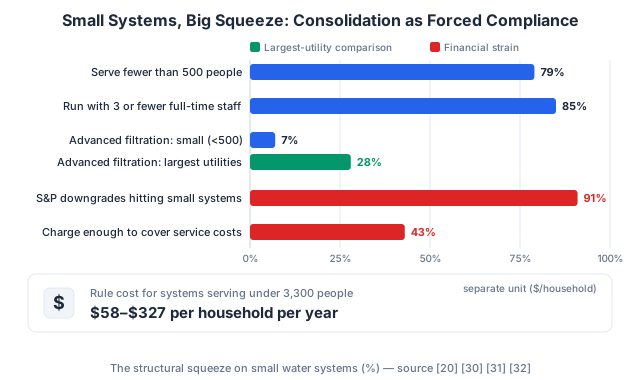
The financial strain is already visible: 91% of S&P Global’s water-utility credit downgrades last year hit small systems [32], and only 43% of utilities charge customers enough to cover service costs at all [32]. Federal funding offers little relief — 61% of Drinking Water State Revolving Fund applicants were small or very small systems, yet only about a third of those projects advanced past the first step [32], and the House budget bill proposed cutting the DWSRF by 19% ($911 million) and the CWSRF by 27% ($1.2 billion), against an administration proposal of roughly 90% cuts to both funds [32].
EPA frames small systems’ struggles as a lack of "technical, managerial, or financial" (TMF) capacity [33], and research from Manny Teodoro finds Safe Drinking Water Act violations drop sharply as connections rise from about 1,100 to 22,000, arguing for consolidation toward roughly 6,000 utilities nationally with a 20,000-connection minimum [34]. Kentucky cut its system count from over 3,000 to under 500 since the 1970s via Senate Bill 409 [33]; California has facilitated about 100 consolidations since 2019, 92% involving systems under 1,000 connections [33]. Watchdogs warn consolidation should proceed only where it improves outcomes for all communities, with power imbalances actively managed in negotiations [33] — a caution set against more than half of the nation’s roughly 50,000 community water systems serving under 500 people and collectively just 1% of the population [34], and EPA’s estimate that 6% to 10% of the 66,000 covered systems will be out of compliance and need remedial action [1].
What to Watch: Litigation, Residuals, and the 2029 Countdown
The rule’s legal status remains unsettled. AWWA and AMWA petitioned the D.C. Circuit in June 2024, arguing EPA ignored more current occurrence data being gathered under UCMR 5 [36]. On February 7, 2025, the court granted EPA a 60-day stay to let the incoming administration reconsider the rule, but in the same order refused to summarily vacate four of the six MCLs [37]. That review produced a split outcome: EPA proposed on May 18, 2026 to rescind the 10 ppt limits for PFHxS, PFNA, and GenX, and the associated Hazard Index standard, citing a Safe Drinking Water Act procedural defect [38], while separately proposing to push the PFOA/PFOS compliance deadline from April 2029 to April 2031, with systems at or above 12 ppt required to take interim mitigation action in the meantime [39]. Administrator Zeldin has stated the 4 ppt PFOA/PFOS limits themselves will stand [7] — though critics note that figure was set at the limit of quantitation, not a toxicological threshold [41].
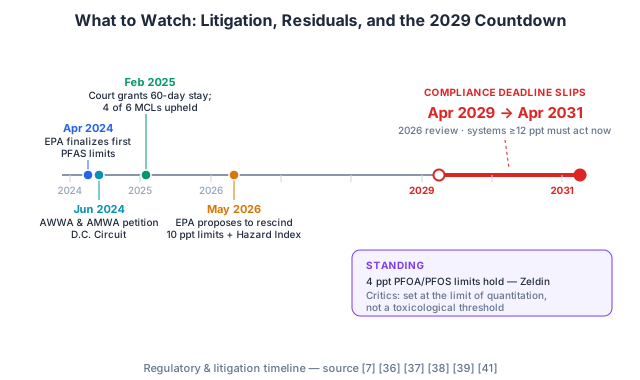
CERCLA exposure compounds the uncertainty: EPA’s liability shield for utilities and biosolids-receiving farms is only an enforcement-discretion policy, not a statutory exemption, leaving third-party cost-recovery suits untouched [25]. A bipartisan bill to codify that protection has sat stalled in subcommittee since April 2024 [40]. Meanwhile, utilities adopting GAC or ion exchange must plan disposal for spent media now — incineration and Subtitle C landfilling are EPA’s approved routes, but state-level moratoriums are narrowing that option [11]. Utilities should treat 2029/2031 not as a fixed date but a moving target, and build residuals-handling and legal contingency into procurement now.
References
- Per- and Polyfluoroalkyl Substances (PFAS) | US EPA — epa.gov — https://www.epa.gov/sdwa/and-polyfluoroalkyl-substances-pfas
- Biden-Harris Administration Finalizes First-Ever National Drinking Water Standard to Protect 100M People from PFAS Pollution | US EPA — epa.gov — https://www.epa.gov/newsreleases/biden-harris-administration-finalizes-first-ever-national-drinking-water-standard
- Fayetteville PWC’s drinking water exceeds new EPA limits for ’forever chemicals’ | CityView NC — cityviewnc.com — https://www.cityviewnc.com/stories/fayetteville-pwcs-drinking-water-vastly-exceeds-new-epa-limit-for-forever-chemicals/
- AMWA Reacts to EPA’s Final PFAS National Primary Drinking Water Regulation — amwa.net — https://www.amwa.net/press-releases/amwa-reacts-epas-final-pfas-national-primary-drinking-water-regulation
- AWWA statement on proposed PFAS drinking water standards — awwa.org — https://www.awwa.org/AWWA-Articles/awwa-statement-on-proposed-pfas-drinking-water-standards/
- Designation of Perfluorooctanoic Acid (PFOA) and Perfluorooctanesulfonic Acid (PFOS) as CERCLA Hazardous Substances | US EPA — epa.gov — https://www.epa.gov/superfund/designation-perfluorooctanoic-acid-pfoa-and-perfluorooctanesulfonic-acid-pfos-cercla
- EPA Announces It Will Keep Maximum Contaminant Levels for PFOA, PFOS | US EPA — epa.gov — https://www.epa.gov/newsreleases/epa-announces-it-will-keep-maximum-contaminant-levels-pfoa-pfos
- Sweeney Treatment Enhancements Project | Cape Fear Public Utility Authority Official Site — cfpua.org — https://www.cfpua.org/775/Sweeney-Treatment-Enhancements-Project
- Brunswick’s new PFAS treatment system expected to launch this spring | Coastal Review — coastalreview.org — https://coastalreview.org/2025/01/brunswicks-new-pfas-treatment-system-expected-to-launch-this-spring/
- Brunswick’s $100-million treatment plant will concentrate contaminants, discharge them back into Cape Fear River | Port City Daily — portcitydaily.com — https://portcitydaily.com/local-news/2018/10/12/brunswicks-100-million-treatment-plant-will-concentrate-contaminants-discharge-them-back-into-cape-fear-river/
- Spent Media Management Pathways for PFAS Treatment Applications (Water Environment Research, 2025) — pmc.ncbi.nlm.nih.gov — https://pmc.ncbi.nlm.nih.gov/articles/PMC12260480/
- Managing and treating per- and polyfluoroalkyl substances (PFAS) in membrane concentrates (AWWA Water Science, 2021) — pmc.ncbi.nlm.nih.gov — https://pmc.ncbi.nlm.nih.gov/articles/PMC8687045/
- Navigating PFAS: Treatment Strategies for Achieving 2029 Compliance | GFT Inc. — gftinc.com — https://www.gftinc.com/blog/navigating-pfas-treatment-strategies-for-achieving-2029-compliance/
- 6 Things for Local Leaders to Know About EPA’s New PFAS Drinking Water Regulations - National League of Cities — nlc.org — https://www.nlc.org/article/2024/04/19/6-things-for-local-leaders-to-know-about-epas-new-pfas-drinking-water-regulations/
- AWWA updates national PFAS cost estimates — Water Finance & Management — waterfm.com — https://waterfm.com/awwa-updates-national-pfas-cost-estimates/
- Persistent Chemicals: Information on EPA’s Analysis of Costs for its PFAS Drinking Water Regulation | U.S. GAO — gao.gov — https://www.gao.gov/products/gao-25-107897
- 3M Settlement with Public Water Suppliers to Address PFAS in Drinking Water Receives Final Court Approval :: 3M Company (MMM) — investors.3m.com — https://investors.3m.com/news-events/press-releases/detail/1836/3m-settlement-with-public-water-suppliers-to-address-pfas
- 3M & DuPont Settlement Deadlines: Guide for Public Water Systems — cleangroundwater.com — https://cleangroundwater.com/3m-and-dupont-pfas-drinking-water-settlements-what-water-systems-should-know-now
- 3M PFAS Settlement Allocation Procedures — investors.3m.com — https://investors.3m.com/financials/sec-filings/content/0000066740-23-000048/exq-allocationprocedures.htm
- Small communities left behind as advanced water treatment for PFAS proves broader benefits - The New Lede — thenewlede.org — https://www.thenewlede.org/2025/09/pfas-water-treatment-utilities/
- EPA’s CERCLA Hazardous Substance Designations for PFOA and PFOS: Case and Agency Updates — americanbar.org — https://www.americanbar.org/groups/environment_energy_resources/resources/newsletters/superfund/epas-cercla-hazardous-substance/
- Trump EPA Announces Next Steps on Regulatory PFOA and PFOS Cleanup Efforts, Provides Update on Liability and Passive Receiver Issues | US EPA — epa.gov — https://www.epa.gov/newsreleases/trump-epa-announces-next-steps-regulatory-pfoa-and-pfos-cleanup-efforts-provides
- Designation of PFOA and PFOS as Hazardous Substances Under CERCLA — Release Reporting Requirements Factsheet | US EPA — epa.gov — https://www.epa.gov/epcra/designation-pfoa-and-pfos-hazardous-substances-under-cercla-release-reporting-requirements
- EPA to retain CERCLA designation for PFAS, support ’passive receivers’ — Water Finance & Management — waterfm.com — https://waterfm.com/epa-to-retain-cercla-designation-for-pfas-support-passive-receivers/
- PFAS Enforcement Discretion and Settlement Policy Under CERCLA | US EPA — epa.gov — https://www.epa.gov/enforcement/pfas-enforcement-discretion-and-settlement-policy-under-cercla
- PFAS Liability and CERCLA: Passive Receiver Exemption Guide — Ferox Strategies — feroxstrategies.com — https://feroxstrategies.com/insight/pfas-and-cercla-understanding-the-passive-receiver-exemption/
- H.R.1267 - Water Systems PFAS Liability Protection Act | Congress.gov | Library of Congress — congress.gov — https://www.congress.gov/bill/119th-congress/house-bill/1267
- Policy Briefing: Bills would protect utilities from Superfund PFAS liability | ASCE — asce.org — https://www.asce.org/publications-and-news/civil-engineering-source/civil-engineering-magazine/article/2023/05/bills-would-protect-utilities-from-superfund-pfas-liability
- EPA Retains CERCLA Hazardous Substance Designations for PFOA and PFOS | Saul Ewing LLP — saul.com — https://www.saul.com/insights/alert/epa-retains-cercla-hazardous-substance-designations-pfoa-and-pfos
- Small water utilities cannot achieve PFAS cleanup on their own - Route Fifty — route-fifty.com — https://www.route-fifty.com/infrastructure/2024/09/small-water-utilities-cannot-achieve-pfas-cleanup-their-own/399605/
- The Uneven Fight Against PFAS In Rural vs. Urban Water Systems - Water Online — wateronline.com — https://www.wateronline.com/doc/the-uneven-fight-against-pfas-in-rural-vs-urban-water-systems-0001
- Broke and On Their Own: Small Water Systems Lose Ground as Federal Support Wavers - Circle of Blue (Brett Walton) — coyotegulch.blog — https://coyotegulch.blog/2026/06/12/broke-and-on-their-own-small-water-systems-lose-ground-as-federal-support-wavers-for-systems-serving-rural-and-low-income-communities-the-finances-were-already-precarious-brett-walton-circleofb/
- State Action on Water System Regionalization and Consolidation – River Network — rivernetwork.org — https://www.rivernetwork.org/state-policy-hub/drinking-water/regionalization-and-consolidation/
- The Sweet Spot - Manny Teodoro — mannyteodoro.com — https://mannyteodoro.com/the-sweet-spot/
- CT water utilities face hundreds of millions in PFAS compliance costs that could reshape industry - Hartford Business Journal — hartfordbusiness.com — https://hartfordbusiness.com/article/ct-water-utilities-face-hundreds-of-millions-in-pfas-compliance-costs-that-could-reshape-industry/
- AWWA v. EPA, No. 24-1188 (D.C. Cir.) — Filed Petition — epa.gov — https://www.epa.gov/system/files/documents/2024-06/awwa-v-epa-no-1188-dc-cir-filed-petition.pdf
- EPA PFAS Drinking Water Rule 60-Day Court Stay on Litigation Challenges — ASDWA — asdwa.org — https://www.asdwa.org/2025/02/13/epa-pfas-drinking-water-rule-60-day-court-stay-on-litigation-challenges/
- Proposed PFAS Rescission Rule — US EPA — epa.gov — https://www.epa.gov/sdwa/proposed-pfas-rescission-rule
- Proposed PFOA and PFOS Compliance Extension Rule — US EPA — epa.gov — https://www.epa.gov/sdwa/proposed-pfoa-and-pfos-compliance-extension-rule
- Regulatory and Litigation Developments — PFAS | Farella Braun + Martel LLP — fbm.com — https://www.fbm.com/per-and-polyfluoroalkyl-substances-pfas/regulatory-and-litigation-developments/
- EPA Scientifically-Challenged PFAS Numbers — American Council on Science and Health — acsh.org — https://www.acsh.org/news/2023/03/28/epa-scientifically-challenged-pfas-numbers-16954