PFAS "Destruction" Claims Outpace the Science That Verifies Them
PFAS "Destruction" Claims Outpace the Science That Verifies Them
Marketed as Destruction, Verified as Removal
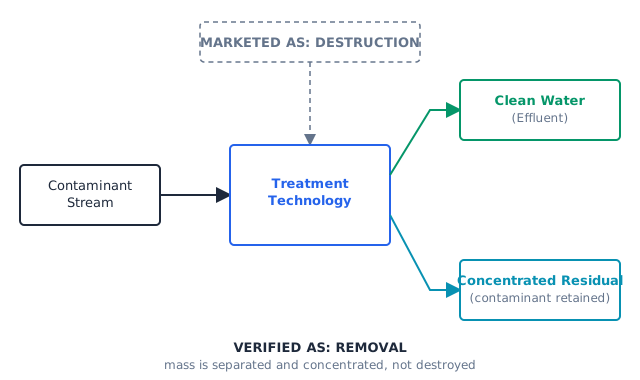
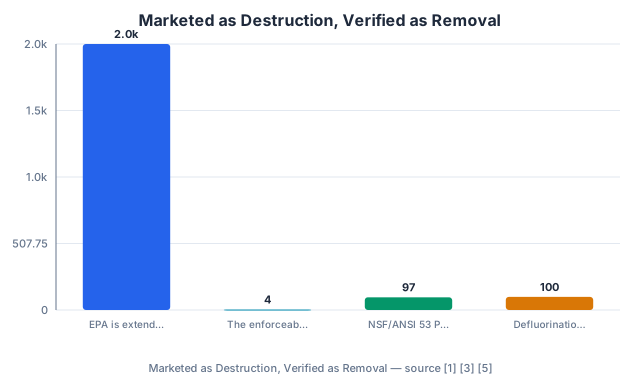
A water utility can now buy PFAS "destruction" equipment, cite a certification, and still have no number showing what fraction of the forever chemicals actually broke down. That gap sits at the center of PFAS regulation and marketing alike. EPA’s enforceable Maximum Contaminant Levels for PFOA and PFOS remain fixed at 4.0 parts per trillion each, even as the agency extends public water systems’ compliance deadline from April 2029 to April 2031 through an opt-in two-year exemption [1]. EPA attributes the extension to falling technology costs, not to gaps in destruction verification [1]. EPA’s 2026 interim guidance on PFAS destruction and disposal sets no numerical destruction-efficiency threshold or required defluorination percentage, citing insufficient information on incineration byproducts and PFAS air emissions [2]. The most common consumer-facing certification, NSF/ANSI 53, perpetuates that gap: it verifies only that a product reduces PFOA and PFOS by at least 97%, with no testing required for short-chain or replacement compounds like PFBS, PFHxA, PFNA, PFHxS, or GenX [3]. Peer-reviewed literature draws a sharper line than any of these frameworks: technologies like adsorption and ion exchange remove PFAS by sequestering it, but do not eliminate or destroy it, while technologies marketed as destructive frequently break carbon-fluorine bonds only partway—generating shorter-chain perfluorinated carboxylic acid transformation products rather than achieving complete mineralization [4]. The result is a regulatory and commercial vocabulary that treats "removal" and "destruction" as interchangeable, when the evidence says they are not.
Why the C-F Bond Resists Hydroxyl Radicals
Removing PFAS is hard for a specific chemical reason: the bond holding fluorine to carbon is exceptionally difficult to break.
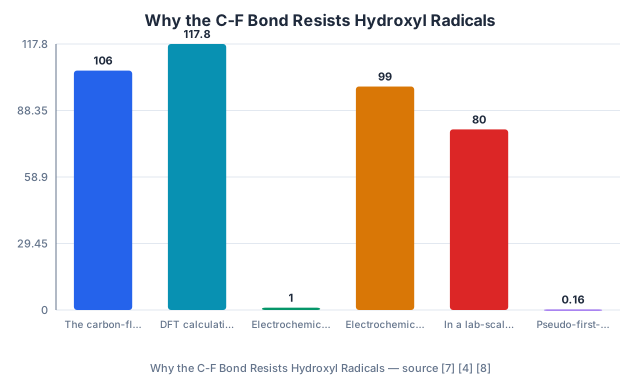
The carbon-fluorine bond is the shortest and strongest known covalent bond in nature, and its exceptional strength confers the thermal and chemical stability underlying PFAS resistance to conventional treatment [4]. Its dissociation energy ranges from roughly 106 to 124 kcal/mol, depending on position in the molecule [7]. DFT calculations by Bentel et al. show this is not uniform: primary C-F bonds on terminal -CF3 groups measure 117.8-123.4 kcal/mol, higher than secondary C-F bonds on internal -CF2- groups at 106.4-113.6 kcal/mol [7]. Chain-end fluorines resist cleavage more than internal ones, which is why degradation proceeds sequentially rather than all at once—electrochemical oxidation of PFOA cleaves terminal CF2/CF3 units one carbon at a time, forming intermediates like the C6F13• radical before ultimately mineralizing to CO2 and HF through hydrolysis [7].
Hydroxyl radicals, the workhorse oxidant of most AOPs, are simply not strong enough to break the C-F bond directly [7]. In electrochemical systems they still play a supporting role alongside direct electron transfer at the anode surface, but their reach is physically constrained: hydroxyl radicals generated at the anode diffuse through a reactive layer less than 1 micrometer thick, sharply limiting contact with dissolved PFAS away from the electrode [7]. This bond strength also explains uneven treatment outcomes: electrochemical oxidation achieves greater than 99% removal for long-chain PFAS, but short-chain compounds—which can themselves form as breakdown byproducts—resist degradation more strongly [4]. It also explains why hydroxyl-radical-only systems like UV/H2O2 underperform: sulfate radicals, not hydroxyl radicals, effectively drive PFAS breakdown, making UV/persulfate systems generating SO4•⁻ more effective than hydroxyl-radical-based UV/peroxide treatment [9].
The Short-Chain Problem AOP Leaves Behind
Where AOP breaks C-F bonds at all, it rarely finishes the job in one pass. Oxidation of long-chain PFAS proceeds through stepwise defluorination: each reaction cycle cleaves carbon-fluorine units rather than mineralizing the molecule, generating shorter-chain intermediates [4]. In photocatalytic AOP, the first cycle removes one carbon and two fluorine atoms from the parent, with subsequent cycles progressively shortening the chain [4].
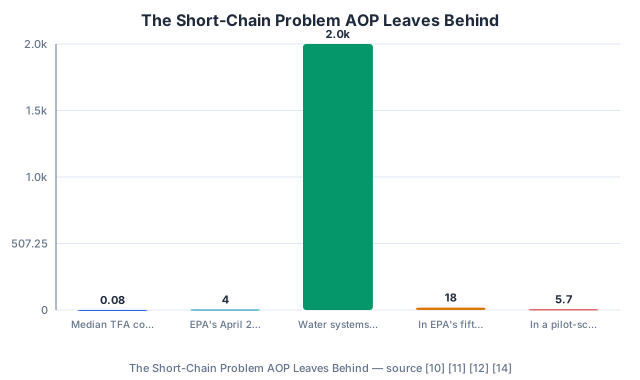
One terminus of this cascade is trifluoroacetic acid, a two-carbon perfluorinated acid that is commonly the final, unreactive degradation product wherever a C-CF3 moiety resists further breakdown [10]. TFA does not sorb to soils or media, so its ultimate destination is the hydrosphere, and removing it from water with current methods is expensive and often ineffective [10]. Median drinking water concentrations already range from 0.08 µg/L in Indiana to 1.5 µg/L in Germany [10], yet TFA—described by researchers as the most abundant PFAS in the environment—has no drinking water MCL at all [10]. Nor do the other short-chain byproducts: EPA’s April 2024 rule set enforceable MCLs only for PFOA and PFOS (4.0 ppt each), PFHxS, PFNA, and HFPO-DA (10 ppt each), with PFBS folded into a Hazard Index and PFBA left unregulated entirely [11]. Compliance runs to 2029, monitoring starts in 2027, and nothing outside those six substances faces any deadline [11]. That matters because PFBA, PFHxA, and PFPeA already turned up in 18–20% of UCMR 5-monitored systems, above a 6 ppt reporting level, without EPA having set even a Health Reference Level for PFBA [12]. Short-chain PFCAs also break through GAC and anion-exchange media earlier than long-chain PFAS, displaced from adsorption sites by higher-affinity compounds [13], forcing more frequent media replacement wherever short-chain criteria are adopted [13]. Pilot-scale ozonation makes the point directly: ∑8PFCA rose 5.7-27.7% post-treatment, evidence of precursors converting into measurable PFAAs rather than being destroyed [14].
The Compliance Paper Trail Utilities Can’t Fully Back
That destruction chemistry gap becomes a regulatory liability once utilities have to prove compliance on paper rather than in a beaker.
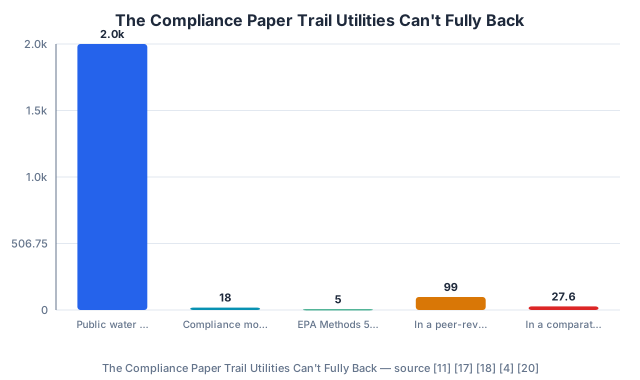
The EPA’s PFAS National Primary Drinking Water Regulation, finalized April 26, 2024, gives public water systems three years to complete initial monitoring—a 2027 deadline—and five years, to 2029, to bring PFAS levels under the new MCLs [11]. Notably, the rule’s own list of Best Available Technologies names granular activated carbon, anion exchange, reverse osmosis, and nanofiltration; AOP is not among them [16]. A citation circulating to support AOP’s regulatory standing (DOI 10.1021/acs.est.6c02502) does not even resolve to a PFAS study—it identifies an unrelated paper on boron compliance in desalination membranes [15], underscoring how thin the documented link between AOP and NPDWR compliance actually is.
Compliance monitoring itself is narrower than utilities may assume: EPA Methods 533 and 537.1 are targeted LC-MS/MS analyses covering 18 named PFAS compounds under 537.1, not a mass-balance or total-organic-fluorine measurement [17]. Both methods were already in use for the fifth Unregulated Contaminant Monitoring Rule (UCMR 5, 2023–2025), and only labs in EPA’s Laboratory Approval Program can report accepted results [18]. The Total Oxidizable Precursor assay, sometimes invoked to catch what LC-MS/MS misses, cannot quantify or identify individual precursor structures and cannot close a full PFAS mass balance [19].
That matters because destruction data is uneven and unverifiable at scale. Electrochemical oxidation achieves >99% removal of long-chain PFAS yet converts precursors to detectable compounds [4]. Only electrochemical oxidation and plasma reactors have undergone pilot-scale field testing [4]; most reported destruction rates, like the 27.6% versus 87.7% UV/persulfate versus UV/sulfite gap [20], stem from lab-scale waste streams rather than real-world conditions.
Standalone Endpoint or Expensive Pretreatment Step
If AOPs can manufacture the very regulated compounds they’re meant to remove, the question is no longer whether the technology works, but what role it can safely occupy in a treatment train.
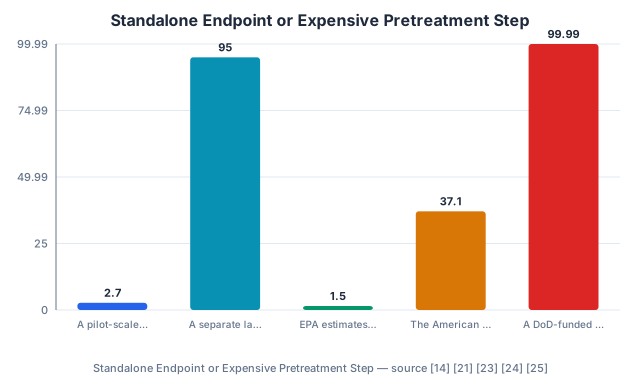
The pilot-scale evidence is unambiguous: ozonation increased total PFCA concentrations by 2.7–17.5% and PFSA by 5.7–32.8%, while O3/H2O2 produced smaller but positive increases—PFCA 1.6–3.7%, PFSA to 32.8%—as unknown precursors were transformed into terminal, regulated PFAA compounds [14]. A separate lab study found the same failure mode at scale: high-dose AOP conditions transformed undetected, longer-chain precursors into detectable shorter-chain PFAS, inflating total measured PFAS by 95% to 340% [21]. The underlying problem is measurement, not just chemistry: peer-reviewed analysis shows that "destruction" claims routinely conflate transformation of a target parent compound with true mineralization, because studies track only a narrow analyte list rather than total fluorine mass balance, and commercial vendors have limited incentive to look for unreported byproducts [22].
Regulators drew their own conclusion. EPA’s final PFAS drinking water rule names GAC, anion exchange, nanofiltration, and reverse osmosis as best available technologies for compliance—AOP appears nowhere on that list [23]. That leaves AOP, at best, as a polishing or pretreatment step ahead of separation technologies that carry a combined national price tag EPA puts at $1.5 billion per year [23], and AWWA’s independent analysis puts roughly double that: $37.1–$48.3 billion in capital investment over five years across more than 7,000 entry points, and $2.7–$3.5 billion annualized [24]. For concentrated PFAS streams, a DoD-funded program is instead pairing foam fractionation—concentrating PFAS up to 200,000:1—with supercritical water oxidation targeting greater than 99.99% destruction, a pairing built specifically to avoid AOP’s precursor-transformation problem [25].
What Utilities Should Watch Before They Sign a Contract
The core question for any procurement is whether a technology destroys PFAS or merely relocates it—and vendors will describe both as "removal." A 2025 review notes that non-destructive techniques don’t eliminate liability, since concentrating PFAS onto sorbents or membranes generates a waste stream that still requires downstream treatment before discharge [26]. Even destructive processes vary sharply in what they actually destroy: the same review documents that long-chain PFAS degradation generates shorter-chain byproducts like PFBA—which accumulate if not further degraded—and that short-chain removal consistently lags long-chain removal [26]. Pilot data confirm this at real scale: electrochemical oxidation degraded long-chain PFAS at a mean of 77-86% but short-chain PFAS at only 22-31%, with extractable organofluorine (a proxy for total defluorination) falling by no more than 44% even when parent-compound degradation reached 84% [27]. The New York State AOP pilot is the starkest warning: target-compound removal by EPA Method 533 looked excellent—100% for PFDA and PFNA, 85-94% for PFOA—while total PFAS concentration rose 95% to 340%, because the process was converting undetected long-chain precursors into detectable, regulated shorter-chain compounds [21]. Utilities should therefore demand full fluoride mass balance evidence, not target-compound disappearance—one destruction vendor markets 98-106% inorganic fluoride recovery as proof that fluorine is actually converting to fluoride rather than shifting form [28]. The most defensible architecture emerging is a two-stage train: concentrate PFAS from dilute raw water via GAC or ion exchange, then send only the concentrated spent regenerant for direct liquid destruction, rather than attempting to destroy PFAS at parts-per-trillion levels [29].
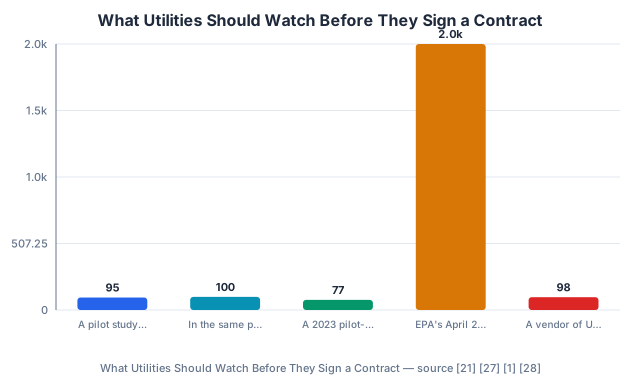
Regulatory pressure continues mounting while these gaps persist. EPA’s April 2024 rule set an April 2029 MCL compliance deadline, and a May 2026 proposal would extend it to 2031 for systems that request it—but only with interim notification and mitigation above 12 ppt in the meantime [1]. Destruction itself is under fresh scrutiny: EPA’s April 2026 interim guidance flags that units operating below recommended temperature thresholds may generate products of incomplete combustion or PFAS air emissions, and calls for emissions testing designed to catch incomplete destruction [2]. Utilities negotiating contracts now should require mass-balance verification, byproduct testing, and air-emissions data as contract deliverables—not assume that a technology’s marketing claims of "removal" or "destruction" have been independently confirmed at the scale being purchased.
References
- Proposed PFOA and PFOS Compliance Extension Rule | US EPA — epa.gov — https://www.epa.gov/sdwa/proposed-pfoa-and-pfos-compliance-extension-rule
- Fact Sheet for the 2026 Interim Guidance on the Destruction and Disposal of PFAS | US EPA — epa.gov — https://www.epa.gov/pfas/fact-sheet-2026-interim-guidance-destruction-and-disposal-pfas
- What NSF/ANSI 53 Actually Tests (And What It Deliberately Leaves Out) - PFAS Research Institute — pfasfilter.io — https://pfasfilter.io/what-nsf-ansi-53-actually-tests-and-what-it-deliberately-leaves-out/
- A Review of PFAS Destruction Technologies - PMC - NIH — pmc.ncbi.nlm.nih.gov — https://pmc.ncbi.nlm.nih.gov/articles/PMC9778349/
- Investigation of Short Chain PFAS Degradation Efficiency Using Free-Standing Boron Doped Diamond Electrodes at High Current Density in a Flow Cell — pmc.ncbi.nlm.nih.gov — https://pmc.ncbi.nlm.nih.gov/articles/PMC12498407/
- Advanced Degradation and Remediation Strategies for Per- and Polyfluoroalkyl Substances (PFASs): Challenges and Future Perspectives (Toxics, 2026) — mdpi.com — https://www.mdpi.com/2305-6304/14/6/499
- A review on the recent mechanisms investigation of PFAS electrochemical oxidation degradation: mechanisms, DFT calculation, and pathways (Frontiers in Environmental Engineering, 2025) — frontiersin.org — https://www.frontiersin.org/journals/environmental-engineering/articles/10.3389/fenve.2025.1568542/full
- Efficient Removal of Perfluorooctanoic Acid by UV-Based Peroxide and Persulfate Advanced Oxidation Processes, Journal of Hazardous, Toxic, and Radioactive Waste, Vol. 27, No. 4 — ascelibrary.org — https://ascelibrary.org/doi/abs/10.1061/JHTRBP.HZENG-1219
- Nanomaterial-Based Advanced Oxidation/Reduction Processes for the Degradation of PFAS (MDPI) — mdpi.com — https://www.mdpi.com/2079-4991/13/10/1668
- The Global Threat from the Irreversible Accumulation of Trifluoroacetic Acid (TFA) (Arp, Gredelj, Glüge, Scheringer, Cousins; Environmental Science & Technology, 30 Oct 2024) — pmc.ncbi.nlm.nih.gov — https://pmc.ncbi.nlm.nih.gov/articles/PMC11562725/
- Per- and Polyfluoroalkyl Substances (PFAS) | US EPA — epa.gov — https://www.epa.gov/sdwa/and-polyfluoroalkyl-substances-pfas
- Making Sense of UCMR 5 Results: Key PFAS Findings, Lithium Concerns, and UCMR 6 Signals — Pace Analytical — pacelabs.com — https://www.pacelabs.com/analytical-environmental/making-sense-of-ucmr-5-results-key-pfas-findings-lithium-concerns-and-ucmr-6-signals/
- PFAS Treatment by Anion Exchange — Enviro Wiki (Strathmann, Ellis, Boyer; sourcing ITRC PFAS Technical and Regulatory Guidance, 2023) — enviro.wiki — https://www.enviro.wiki/index.php?title=PFAS_Treatment_by_Anion_Exchange
- Pilot Assessment of Impacts of Ozone and Ozone/Hydrogen Peroxide Treatment on the Fate of Per- and Polyfluoroalkyl Substances and Precursors (Xin, Kim, Weng, Huang; ACS ES&T Water, Sept 25 2024) — pmc.ncbi.nlm.nih.gov — https://pmc.ncbi.nlm.nih.gov/articles/PMC11474954/
- Crossref metadata for DOI 10.1021/acs.est.6c02502 — api.crossref.org — https://api.crossref.org/works/10.1021/acs.est.6c02502
- EPA Issues First-Ever Drinking Water Standards for PFAS — Bergeson & Campbell, P.C. — lawbc.com — https://www.lawbc.com/epa-issues-first-ever-drinking-water-standards-for-pfas/
- EPA Method 537.1 for PFAS in Drinking Water | UCT — unitedchem.com — https://www.unitedchem.com/epa-method-537-1/
- EPA PFAS Testing: 533 vs 537.1 vs 1633 Method Comparison | ALS Global — alsglobal.com — https://www.alsglobal.com/en/news-and-publications/2024/09/pfas-sampling-methods-epa-533-vs-537_1-vs-1633
- Total Oxidizable Precursor (TOP) Assay — Best Practices, Capabilities and Limitations for PFAS Site Investigation and Remediation, Environmental Science & Technology Letters — pubs.acs.org — https://pubs.acs.org/doi/10.1021/acs.estlett.3c00061
- Electrochemical advanced oxidation of per- and polyfluoroalkyl substances (PFASs): Development, challenges and perspectives, ScienceDirect — sciencedirect.com — https://www.sciencedirect.com/science/article/pii/S1385894724087138
- Advanced oxidation processes may transform unknown PFAS in groundwater into known products, Chemosphere (Ersan, Wang, Wong, Westerhoff, Feb. 2024) — pubmed.ncbi.nlm.nih.gov — https://pubmed.ncbi.nlm.nih.gov/38048829/
- The Need to Include a Fluorine Mass Balance in the Development of Effective Technologies for PFAS Destruction, Environmental Science & Technology (Smith et al., Feb. 2024) — pmc.ncbi.nlm.nih.gov — https://pmc.ncbi.nlm.nih.gov/articles/PMC10867837/
- EPA Finalizes PFAS Drinking Water Regulation, Holland & Knight — hklaw.com — https://www.hklaw.com/en/insights/publications/2024/04/epa-finalizes-pfas-drinking-water-regulation
- AWWA updates national PFAS cost estimates, Water Finance & Management (Sept. 20, 2024) — waterfm.com — https://waterfm.com/awwa-updates-national-pfas-cost-estimates/
- Long-term On-site Removal and Destruction of PFAS Using Surface Active Foam Fractionation and Supercritical Water Oxidation, SERDP-ESTCP (DoD) — serdp-estcp.mil — https://serdp-estcp.mil/projects/details/487bc1ac-b3f8-4f58-b5c1-61e1dd8a8c17/long-term-on-site-removal-and-destruction-of-pfas-using-surface-active-foam-fractionation-and-supercritical-water-oxidation
- npj Clean Water, Vol. 8, Art. 41 (Tshangana et al., May 15, 2025) — nature.com — https://www.nature.com/articles/s41545-025-00457-3
- ACS ES&T Water (Smith, Lauria, Ahrens, McCleaf, Hollman, et al., March 15, 2023) — pmc.ncbi.nlm.nih.gov — https://pmc.ncbi.nlm.nih.gov/articles/PMC10111409/
- UV PFAS Destruction, Parsons Corporation — parsons.com — https://www.parsons.com/uv-pfas-destruction/
- Water Environment Research (Ling et al., July 2025) — pmc.ncbi.nlm.nih.gov — https://pmc.ncbi.nlm.nih.gov/articles/PMC12260480/