When A Chemistry Journal Article Becomes A Water-Sector Blind Spot
When A Chemistry Journal Article Becomes A Water-Sector Blind Spot
When A Chemistry Journal Article Becomes A Water-Sector Blind Spot
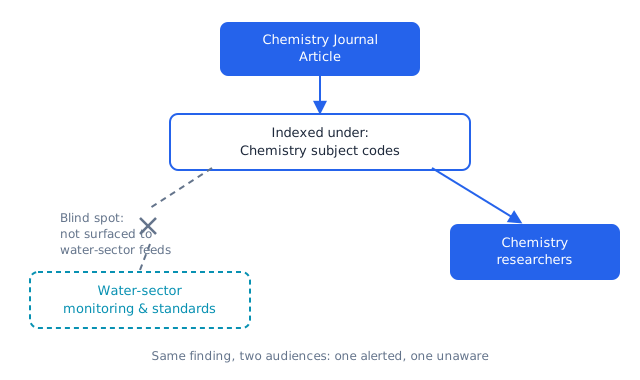
A Food & Function review — "Application of artificial intelligence in synbiotic and functional food development for precision nutrition," by Janani B. and Samuel Ayofemi Olalekan Adeyeye (DOI 10.1039/D6FO00295A) — makes a claim that should unsettle anyone tracking process-water demand: synbiotic and functional food formulation, long an empirical trial-and-error discipline, is being restructured around AI/ML as the primary tool for navigating nonlinear trade-offs among probiotic viability, prebiotic functionality, and sensory acceptance [1]. That reordering is not theoretical. Nuritas Ltd.’s published bioactive-peptide discovery framework now runs AI ahead of laboratory screening — benefit definition, then bioactive prediction, then food source identification, then bioactive release, then validation — with models trained on LC-MS/MS peptidomics that characterizes peptides released by mild hydrolysis of parent proteins, a step whose yield depends on process conditions [2]. A 2026 quasi-systematic review in Food Chemistry: X, authored by Nadia Alkalbani and 11 co-authors (DOI 10.1016/j.fochx.2026.103628), demonstrates AI models optimizing anthocyanin extraction trained directly on solid-liquid ratio, ethanol concentration, ultrasonic temperature, and pectinase dosage [3].
None of these papers appear to address water treatment, water quality, or utility operators. Yet solid-liquid ratio and mild hydrolysis are water-mediated unit operations. A November 2025 review by Oz & Oz in Foods (DOI 10.3390/foods14223919) confirms most current AI formulation systems still run offline on static datasets, but calls for future integration with real-time process sensors and supply-chain data — and in laying out which stakeholders should govern shared data platforms, names academic, industrial, and regulatory parties, but not the process-input suppliers who control water quality and availability [4]. That omission is the blind spot this analysis examines.
The Hidden Input: Feedwater Quality As Unvalidated Training Data
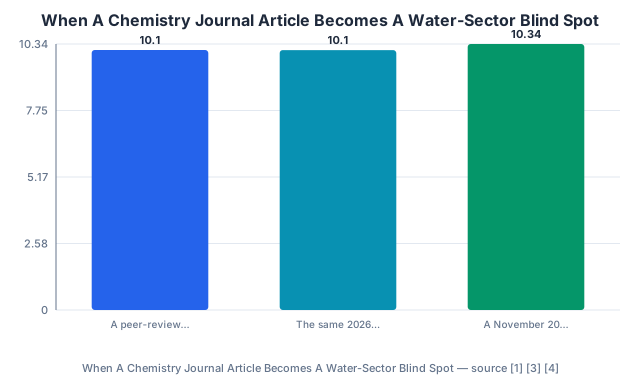
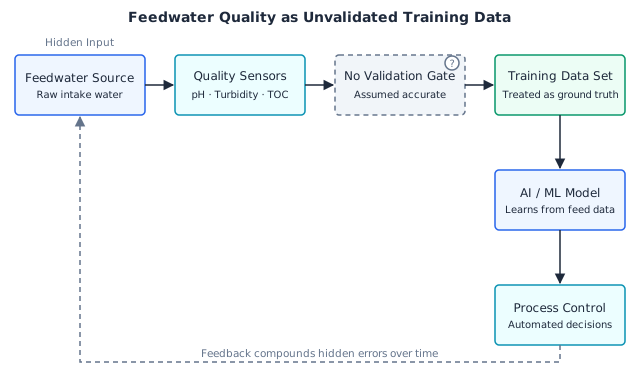
The AI models synthesized across that 2020–2025 literature optimize formulation, viability, bioactivity, and sensory outcomes — but none of the reviewed work appears to treat feedwater chemistry itself as a modeled input [1]. That is a structural blind spot, not a minor omission. Every ingredient parameter these models predict is downstream of water that carries its own unmeasured variability into the process.
Take chlorination: residual chlorine in fermentation make-up water reacts directly with organic growth factors like biotin and thiamine, inactivating them or converting them into growth-inhibitory derivatives — meaning a fermentation-viability model trained without dechlorination status as a feature is implicitly assuming a water quality precondition it never validates [5]. Moisture carries similar hidden leverage: feed material must sit below 10% moisture before supercritical CO2 extraction, since yield falls as moisture content rises, yet moisture is a property inherited from upstream water handling as much as from the raw material itself [6]. And in enzymatic hydrolysis, raising substrate concentration reduces available free water and water activity, which in turn can markedly reduce the relative overall hydrolysis rate — a water-availability effect, not a substrate-chemistry effect, masquerading as a formulation variable [7].
In each case, the AI pipeline treats a water-quality parameter — residual disinfectant, moisture fraction, water activity — as a fixed or ignored background condition rather than a labeled feature. A model can be perfectly optimized on ingredient-selection or bioactivity data and still fail in production because the feedwater it was trained against was never characterized, let alone controlled, as part of the dataset.
The Purity Premium: Why Precision Formulation Demands Pharma-Grade Water
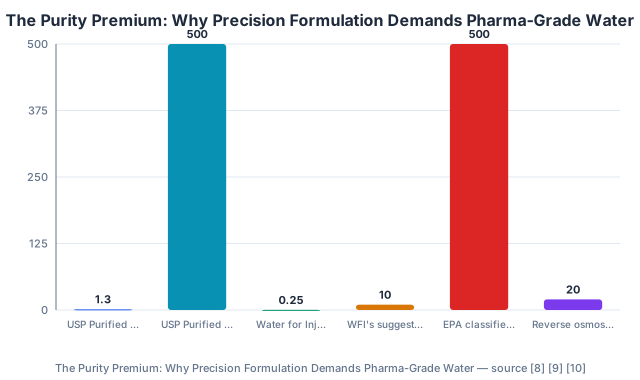
AI can tune a fermentation or formulation process to a fine tolerance, but the water feeding that process sets the ceiling on how much precision actually survives into the finished ingredient. USP Purified Water and USP Water for Injection (WFI) share an identical conductivity limit of no more than 1.3 µS/cm at 25°C [8] and an identical Total Organic Carbon ceiling of 500 ppb [8] — the two grades start from the same physicochemical baseline. They diverge on biological control: WFI carries a bacterial endotoxin limit of no more than 0.25 EU/mL, a parameter Purified Water doesn’t specify at all [8], and WFI’s suggested aerobic bacteria action limit of under 10 cfu per 100 mL is roughly three orders of magnitude (about 1,000-fold) tighter than Purified Water’s suggested 100 cfu/mL [8]. Against municipal water, the gap is starker still: the EPA treats total dissolved solids as a secondary, non-enforceable aesthetic standard with a recommended maximum of 500 ppm [9] — far looser than the near-zero dissolved-solids level implied by a purified-water grade’s tight conductivity ceiling [9]. For an AI-optimized fermentation process modeling cell growth, productivity, and metabolic flux to predictable endpoints [14], water carrying variable dissolved solids or uncontrolled bioburden reintroduces exactly the noise the model was built to eliminate.
That purity carries a capital cost. Reverse osmosis systems used to produce pharmaceutical- and biopharmaceutical-grade water typically reject 20-25% of feed water as concentrate, with some configurations rejecting up to 50% [10], and zero liquid discharge remains an aspirational, rarely fully implemented target because of the scale of investment it requires [10]. Vendors are already positioning this equipment for nutraceutical producers: Veolia markets pharmaceutical-grade water purification systems directly to nutraceutical, botanical, and enzyme manufacturers, not only to drug and device makers [13]. The economics support the pitch. The global pharmaceutical water market was valued at $47.47 billion in 2025 and is projected to reach $105.5 billion by 2035 at an 8.31% CAGR [11], with Water for Injection alone holding 79% share in 2025 [11] — while the nutraceutical CDMO market that would absorb any pharma-grade water capex was valued at $35.10 billion in 2024, projected to reach $55.39 billion by 2030 at a 7.9% CAGR [12].
Regulatory Lag: Novel-Ingredient Approval Outpacing Discharge Permitting
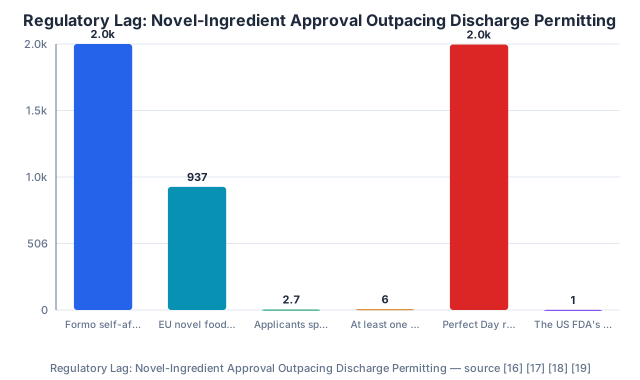
Precision fermentation’s design cycle now moves faster than either the food-safety or the water-discharge regulators can track it. In the US, the FDA’s self-affirmed GRAS pathway lets a company market a new ingredient without notifying the agency or disclosing safety data publicly, since the underlying dossier can stay proprietary [15]. HHS Secretary Robert F. Kennedy Jr. has said manufacturers have exploited this loophole to introduce ingredients "with unknown safety data" into the food supply with no notice to FDA or the public [15], and FDA’s proposed rule to close it would not apply retroactively to substances already GRAS-listed or holding a "no questions" letter [15]. Formo illustrates the dual-track reality: it self-affirmed its precision-fermented casein as GRAS in December 2024, clearing it for market, while a separate formal GRN 1312 notification remained pending [16]. The US-EU gap is stark. GRAS can put an ingredient on shelves in roughly a year, versus 2.5 to 4-plus years under EU Novel Food/EFSA review [19], where the average time to an EFSA opinion is 937 days and nearly half of that is spent answering an average 2.7 rounds of additional data requests [17]. One ingredient reached US market in under six months while sitting unresolved in EFSA review five years after submission [17]; Perfect Day’s whey protein got FDA clearance in 2020 but wasn’t filed in the EU until 2022, still unassessed as of the report [18]. By 2026, multiple fermentation-derived proteins had cleared in the US against what the cited trade-press review reports as none yet approved in Europe [19].
That asymmetry matters upstream of the fermenter, not just at the retail shelf. AI-driven functionality-first design accelerates the front end — linking molecular and mesoscopic features to macroscopic outcomes — but these models often fail to generalize across ingredients and process conditions [22], meaning each new candidate still demands bespoke pilot-scale validation. Under EPA’s NPDES rules, "process wastewater" legally captures any byproduct or waste-product stream from manufacturing [21], so scale-up facilities — which can cost hundreds of millions of dollars in capex [20] — trigger discharge permitting obligations regardless of how quickly the ingredient itself cleared GRAS review. An industry executive has already flagged US manufacturing infrastructure, not fermentation technology, as the binding constraint on scaling [20]; discharge permitting sits squarely inside that infrastructure bottleneck, decoupled from and lagging behind the ingredient-approval timeline.
The Real Savings: R&D Speed Versus Treatment And Monitoring Costs
The formulation gains described above compress design cycles, but they sit upstream of where most precision-fermentation dollars are actually spent. Perfect Day’s digital-twin approach — simulating 10,000-L fermentation tanks to skip physical pilot trials — cuts commercialization costs by 40% while holding batch consistency above 99% — figures Perfect Day reports for its own process [23]. That is a genuine, quantified saving, but it is bounded to the R&D and scale-up phase. For a 200,000-L fermenter at commercial scale, downstream processing runs 15-20% of total precision fermentation COGS and utilities another 8-12% [24] — cost categories the digital-twin work does not touch. Capital expenditure for a food-grade facility at 100,000-200,000 L scale sits at $150-300M [24], a bucket set by bioreactor engineering and purification infrastructure, not by how the formulation itself was designed.
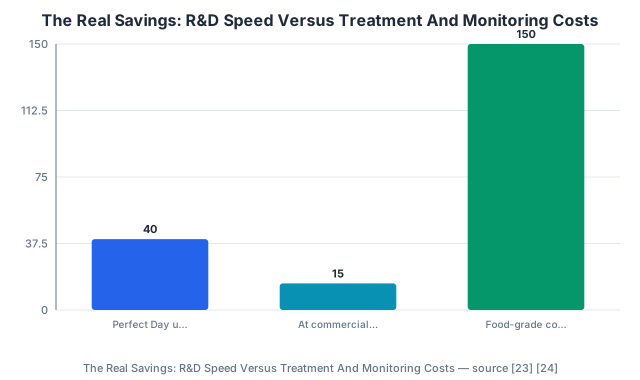
A review of AI-enabled ingredient substitution notes that the deep learning models driving these formulation gains remain interpretability-limited "black boxes," which constrains transparency in a regulated domain [4]. Commercial platforms from NotCo, Climax Foods, and Perfect Day integrate proprietary historical performance, sensory, and textural data, and such platforms’ specific methodologies are generally not publicly disclosed, which limits independent third-party validation [4]. That opacity is consistent with where industry sentiment has landed: a March 2026 FoodNavigator panel on AI in functional foods was framed around whether "AI" means artificial intelligence or active ingredients, and panelists concluded that active ingredients and proven science remain the priority over AI-driven storytelling [25]. The 40% figure — Perfect Day’s own reported number [23] — describes design speed — not the treatment, downstream, and capital costs that still set the price of the finished ingredient.
What To Watch: The Instrumentation And Data Supply Chain
The gating factor for AI-driven ingredient design has moved from modeling capability to data supply. An April 2026 preprint on AI for food innovation states plainly that the field’s bottleneck is "no longer algorithmic capacity but high-quality data acquisition," and notes that industrial data sharing among food and ingredient manufacturers remains rare, with mechanical, rheological, visual, and compositional data staying multimodal, unstructured, and largely unfused across firms [22].
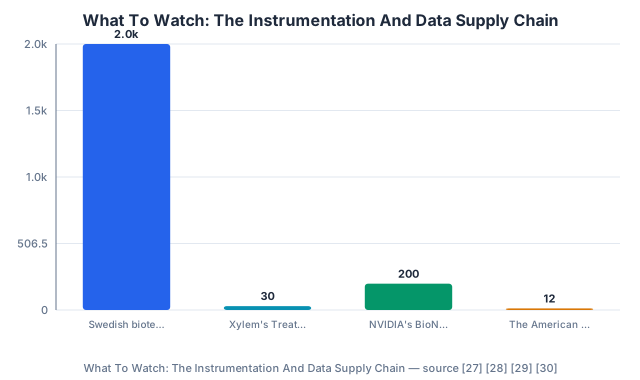
That gap is visible at both ends of the pipeline. On the analytical-instrumentation side, Thermo Fisher’s 2026 acquisitions of MSAID and Proteinaceous fold machine-learning spectral interpretation directly into its Orbitrap platform, and the same ASMS 2026 rollout added a dioxin/POP mass spectrometer with more than double the resolution of many existing systems plus new PFAS and pesticide screening instruments — infrastructure that expands what can be measured, not yet what gets shared [26]. On the production side, Curve’s partnership with Digital Tvilling aims to build continuous data collection and graph-based modeling directly into precision fermentation, with the CEO framing the goal as a system where "every production run contributes to making the system smarter," rather than a static model trained once and deployed; first integrated capabilities are due in 2026 [27].
Water utilities illustrate how far the instrumentation layer still lags the modeling ambition even in AI’s more mature deployments. Xylem’s Treatment System Optimization software cut aeration energy 30% (1.1 million kWh/year) at EWE WASSER’s Cuxhaven plant using machine learning on existing SCADA data — but the plant had no online sensors for real-time influent measurement, forcing Xylem to build virtual sensors instead of feeding models with direct readings [28]. NVIDIA’s BioNeMo, with 200+ users as of November 2024, shows cloud compute for generative molecular design is already commoditized for pharma and biotech [29] — but its customer base has not yet crossed into food and ingredients. The AWWA’s February 12–13, 2026 "AI, Data, and Water" roundtable devoted a session to utility data collection, signaling the water sector is organizing around AI questions primarily as data consumers, not as suppliers of process data into ingredient-design markets [30]. Whether that data starts flowing outward — from plant floor and treatment works alike — is the next constraint to watch.
References
- Application of artificial intelligence in synbiotic and functional food development for precision nutrition | Food & Function | Royal Society of Chemistry — pubs.rsc.org — https://pubs.rsc.org/fo/article-abstract/doi/10.1039/d6fo00295a/1259044/Application-of-artificial-intelligence-in?redirectedFrom=fulltext
- Artificial Intelligence in Functional Food Ingredient Discovery and Characterisation: A Focus on Bioactive Plant and Food Peptides (Frontiers in Genetics, 2021) — pmc.ncbi.nlm.nih.gov — https://pmc.ncbi.nlm.nih.gov/articles/PMC8640466/
- Artificial intelligence in functional food innovation: Bioactive enhancement and formulation optimization: A quasi-systematic review (Food Chemistry: X, 2026) — pmc.ncbi.nlm.nih.gov — https://pmc.ncbi.nlm.nih.gov/articles/PMC12914456/
- Artificial Intelligence-Enabled Ingredient Substitution in Food Systems: A Review and Conceptual Framework for Sensory, Functional, Nutritional, and Cultural Optimization (Foods, 2025) — pmc.ncbi.nlm.nih.gov — https://pmc.ncbi.nlm.nih.gov/articles/PMC12651232/
- US4226939A — Treatment of make-up water for use in a fermentation process for growth of yeast cells requiring growth factors — patents.google.com — https://patents.google.com/patent/US4226939A/en
- Green Extraction of Plant Materials Using Supercritical CO2: Insights into Methods, Analysis, and Bioactivity — Plants (Basel), 2024 — pmc.ncbi.nlm.nih.gov — https://pmc.ncbi.nlm.nih.gov/articles/PMC11359946/
- Influence of water availability on the enzymatic hydrolysis of proteins — Biochemical Engineering Journal — sciencedirect.com — https://www.sciencedirect.com/science/article/abs/pii/S1359511314004395
- Quick Reference Compendial Water Standards - AQUA-CHEM — aqua-chem.com — https://aqua-chem.com/compendial-water-standards/
- TDS Levels In Drinking Water: Safe Ranges, Chart, And What The Numbers Mean | AMPAC USA — ampac1.com — https://www.ampac1.com/blog/tds-levels-drinking-water-complete-guide/
- Zero Liquid Discharge in Biopharmaceutical Production | Pharmaceutical Engineering (ISPE) — ispe.org — https://ispe.org/pharmaceutical-engineering/march-april-2018/zero-liquid-discharge-biopharmaceutical-production
- Pharmaceutical Water Market Size to Reach USD 105.5 Billion by 2035 - Precedence Research — precedenceresearch.com — https://www.precedenceresearch.com/pharmaceutical-water-market
- Nutraceutical CDMO Guide: Services, Market Size & How to Choose the Right Partner - PharmaSource — pharmasource.global — https://pharmasource.global/content/guides/category-guide/nutraceutical-cdmo-guide-services-market-size-how-to-choose-the-right-partner/
- Pharmaceutical Water Treatment Systems | Veolia — watertechnologies.com — https://www.watertechnologies.com/industries/pharmaceuticals
- Transforming Ingredients Through Precision Fermentation - Food Technology Magazine (IFT) — ift.org — https://www.ift.org/news-and-publications/food-technology-magazine/issues/2025/march/columns/processing-transforming-ingredients-through-precision-fermentation
- FDA Proposes Rule to End ’Self-Affirmed’ GRAS in 2026 — Green Queen — greenqueen.com.hk — https://www.greenqueen.com.hk/fda-proposed-rule-unified-agenda-end-self-affirmed-gras/
- Formo Wins US GRAS Clearance for Precision-Fermented Casein Protein — mycostories.com — https://www.mycostories.com/post/formo-wins-us-gras-clearance-for-precision-fermented-casein-protein
- Five-year waits and rising costs: Is Europe’s Novel Food system holding innovation back? — NutraIngredients — nutraingredients.com — https://www.nutraingredients.com/Article/2026/07/13/eu-novel-food-approval-delays-threaten-europes-food-innovation/
- Precision fermentation dairy seeks EFSA approval: What we know so far — FoodNavigator — foodnavigator.com — https://www.foodnavigator.com/Article/2024/04/17/Precision-fermentation-dairy-seeks-EFSA-approval-What-we-know-so-far/
- Precision fermentation is ready. EU novel food approval isn’t. — BioSafe — biosafe.fi — https://www.biosafe.fi/insight/precision-fermentation-is-ready-eu-novel-food-approval-isnt
- Precision fermentation firms face scale-up struggles — FoodNavigator — foodnavigator.com — https://www.foodnavigator.com/Article/2026/03/30/precision-fermentation-firms-face-scale-up-struggles/
- 40 CFR § 122.2 — Definitions | Cornell Legal Information Institute — law.cornell.edu — https://www.law.cornell.edu/cfr/text/40/122.2
- Artificial Intelligence for Food Innovation (arXiv preprint) — arxiv.org — https://arxiv.org/html/2509.21556v2
- Precision to plate: AI-driven innovations in fermentation and hyper-personalized diets (Frontiers in Nutrition, 04 September 2025) — frontiersin.org — https://www.frontiersin.org/journals/nutrition/articles/10.3389/fnut.2025.1659511/full
- Precision Fermentation Economics: Can You Compete at $25/kg? | BioProcess Tools — bioprocesstools.com — https://bioprocesstools.com/blog/precision-fermentation-economics/
- Artificial intelligence is boosting R&D and storytelling for functional foods, but researchers say active ingredients and proven science remain the priority (FoodNavigator, 27 March 2026, by Timothy Inklebarger) — foodnavigator.com — https://www.foodnavigator.com/Article/2026/03/27/artificial-intelligence-is-boosting-rd-and-storytelling-for-functional-foods-but-researchers-say-active-ingredients-and-proven-science-remain-the-priority/
- Thermo Fisher Expands Orbitrap Platform Across Research, Biopharma and Environmental Testing at ASMS 2026 — Lab Manager — labmanager.com — https://www.labmanager.com/thermo-fisher-expands-orbitrap-platform-across-research-biopharma-and-environmental-testing-at-asms-2026-35554
- Curve and Digital Tvilling partner on AI-driven precision fermentation platform — FoodBev Media — foodbev.com — https://www.foodbev.com/news/curve-and-digital-tvilling-partner-on-ai-driven-precision-fermentation-platform
- Wastewater treatment plant uses AI to reduce aeration energy use by 30 percent — Xylem — xylem.com — https://www.xylem.com/en-us/making-waves/water-utilities-news/wastewater-treatment-plant-uses-ai-to-reduce-aeration-energy-use-by-30-percent/
- NVIDIA Opens BioNeMo to Scale Digital Biology for Global Biopharma and Scientific Industry — NVIDIA Newsroom — nvidianews.nvidia.com — https://nvidianews.nvidia.com/news/nvidia-opens-bionemo-to-scale-digital-biology-for-global-biopharma-and-scientific-industry
- AI, Data, Data Centers: Strategies and Opportunities for the Water Sector — American Water Works Association — awwa.org — https://www.awwa.org/event/AI-Data-and-Water/