Who Pays for the EU’s Micropollutant Cleanup
Who Pays for the EU’s Micropollutant Cleanup
The Compliance Clock Utilities Can’t Stop
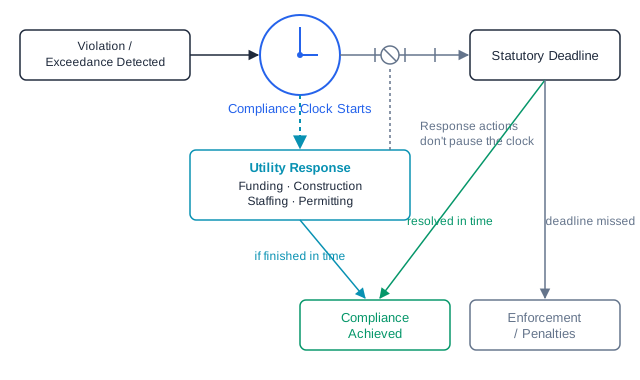
By 31 December 2028 — roughly 17 months from the recast Urban Wastewater Treatment Directive’s national transposition deadline of 31 July 2027 — pharmaceutical and cosmetics producers across the EU must be funding at least 80% of the total costs of quaternary treatment — investment, operational, monitoring, and data collection [3]. That single date compresses what utilities would normally treat as a multi-decade capital planning question into a scramble to stand up extended producer responsibility (EPR) mechanisms, cost-recovery contracts, and monitoring infrastructure almost immediately after the directive enters national law [3]. Plants of 150,000 population equivalent (p.e.) and above must hit quaternary treatment — removing at least 80% of a defined list of micropollutants — for 20% of such plants by 31 December 2033, 60% by 31 December 2039, and all of them by 31 December 2045 [1][2]. Smaller plants, down to 10,000 p.e., face the same 2045 deadline wherever they discharge into drinking-water catchments, bathing waters, or aquaculture areas [2]. Additionally, treatment plants across the EU must reach energy neutrality by 2045 [5] — though, as this piece later details, at least one technical analysis reads the directive’s compliance table as setting an earlier 2040 deadline for smaller plants.
Two clocks are running, but only one has money attached from day one. Producers — responsible for an estimated 92% of the toxic load found in urban wastewater, per a 2022 Bio Innovation Service study [19] — become the primary funders under EPR [7][19], yet a legal analysis citing the Commission’s impact assessment pegs EU-wide annual costs at roughly €1.2 billion [4], a figure industry and national analyses reject as a severe undercount. That gap is the utility’s real planning problem.
Who Actually Pays and How the Fee Is Set
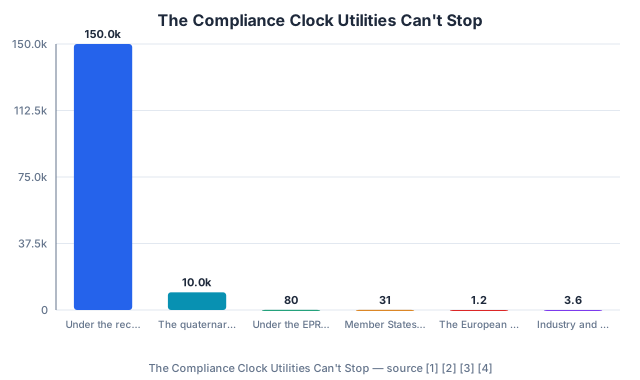
Once a plant is slated for quaternary treatment, the question becomes who funds the build-out — and the recast Directive answers it with extended producer responsibility. Pharmaceutical and cosmetics producers must fund at least 80% of the investment and operational costs of quaternary treatment [8], with each company’s individual contribution calculated according to the quantity and hazardousness of the substances it places on a given Member State’s market [8]. A separate legal analysis puts the required producer share even higher for some cost categories — 100% of data-gathering costs and 100% of other administrative costs, versus at least 80% for quaternary treatment itself [16]. Producers become subject to these EPR obligations from 31 December 2028 [10].
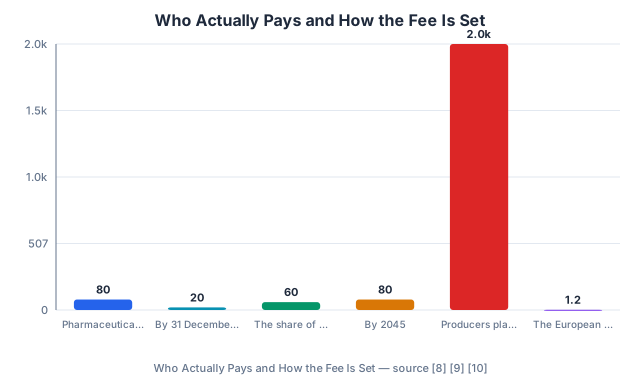
Cost estimates diverge sharply. A legal analysis reports that the European Commission has put the EPR-funded treatment stage at roughly €1.2 billion per year EU-wide [10]. EFPIA cites the Commission’s estimate at up to €1.4 billion per year through 2045 [11] — higher than the roughly €1.2 billion EU-wide figure cited earlier in this piece — though national assessments in some Member States run three to five times higher [11]. AESGP goes further, noting actual implementation costs are running three to eight times above original projections [12]. Germany alone puts annual costs at €885 million to €1.025 billion [4] — approaching the Commission’s entire EU-wide estimate for a single Member State. EurEau, representing European water utilities, estimates total EU costs at €3.6 billion to €11.3 billion depending on upgrade scope [4].
Producer groups argue the funding formula is unworkable for pharmaceuticals specifically. EFPIA notes that fixed and regulated medicine pricing prevents companies from passing EPR costs through to patients, forcing direct absorption that could threaten supply continuity [11]. AESGP warns this could push producers to withdraw economically marginal, low-priced medicines from the EU market [12], a concern echoed in industry-side legal commentary warning of outright product withdrawals where compliance costs are excessive [4]. AESGP also disputes the 80% cost-coverage threshold itself, pointing to the Commission’s own research acknowledging difficulty in directly linking specific product sources to measured micropollutant concentrations [12].
The Legal and Lobbying Fight Over Who’s Captured
Those funding obligations did not go unchallenged: the pharmaceutical industry brought legal challenges to the EU’s courts. EFPIA, the European pharmaceutical trade association, filed an application with the EU General Court on 10 March 2025 challenging the UWWTD’s extended producer responsibility provisions, arguing they breach the polluter-pays principle, proportionality, and non-discrimination [13]. Director General Nathalie Moll framed EFPIA’s position not as opposition to polluter-pays itself but as a demand that all producers be held accountable based on the volume and hazardousness of their substances — not pharma alone [13].
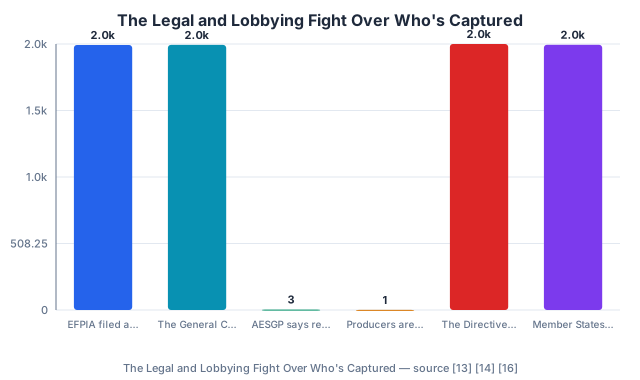
According to AESGP, the General Court dismissed the action (case T-158/25) on 18 February 2026 on procedural grounds: EFPIA had not demonstrated it was individually concerned by the contested provisions, so the court, per AESGP’s account, never ruled on the substantive claims about proportionality, legal certainty, or polluter-pays [14]. AESGP, representing self-care and cosmetics manufacturers, has pressed the substantive case in parallel, arguing revised cost estimates for the EPR scheme now run three to eight times higher than initially predicted, and calling the scheme disproportionate, discriminatory, and scientifically unsupported for targeting pharma and cosmetics while pesticides, PFAS, household chemicals and industrial sources of micropollutants go unaddressed [14].
EFPIA said it will not appeal the dismissal, but will maintain the challenge through a parallel case brought by the Irish Pharmaceutical Healthcare Association in Ireland’s High Court, seeking a preliminary reference to the CJEU on the Directive’s validity [15]. The scope question remains unsettled: Annex III currently captures only human medicines and cosmetics, exempting producers placing under 1 tonne per year on the EU market or whose substances are rapidly biodegradable [16], while the Commission is required to assess expanding the list with any proposals due by 31 December 2033 [16]. Until such litigation and scope determinations are resolved, utilities must plan compliance timetables for a directive whose cost allocation remains contested in court.
A Manufacturing Lever for a Distribution Problem
The EPR levy targets producers, but the pollution it’s meant to fund treatment for may not primarily originate at the factory gate. EFPIA states that effluents from pharmaceutical production sites are already strictly monitored and minimized under existing environmental standards [17], while between 30% and 90% of an orally administered drug dose is excreted in urine [18] — suggesting patient consumption, not manufacturing discharge, may be the larger route by which active residues reach urban wastewater. The Commission’s case for taxing pharmaceutical and cosmetics makers rests on a 2022 Bio Innovation Service study attributing roughly 92% of the micropollutant toxic load, measured by predicted no-effect concentration, to those two sectors’ products [19]. Industry disputes that figure, arguing an alternative published estimate of 66% rests on flawed PNEC assumptions and methodological errors rather than measured wastewater concentrations [17].
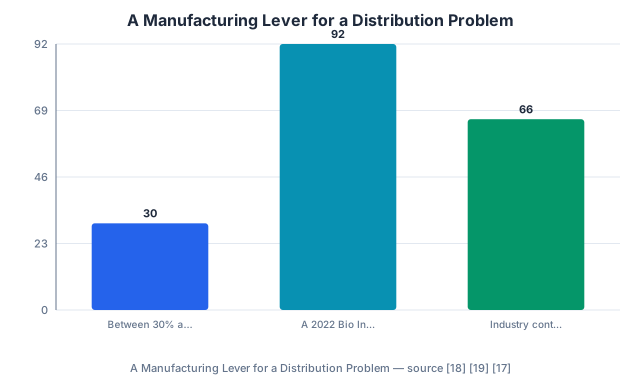
The mismatch sharpens once the fee mechanism is examined. Each producer’s contribution under the recast UWWTD is set by the quantity and hazardousness of substances in the products it places on a given Member State’s market [20] — a sales-volume proxy, not a measurement of actual downstream pollution. Industry groups argue this leaves companies facing costs disproportionate to their real contribution to water pollution [11]. And because the charge attaches to market placement rather than to prescribing, disposal, or consumption behavior, critics contend it creates no incentive for the two taxed sectors — or any other polluter — to develop greener products [11]. The lever sits at manufacturing; much of the problem it’s pulling on may sit at the tap and the toilet.
Switzerland’s Head Start and How the EU’s Model Compares
The EU’s 80% producer-funded model didn’t emerge in a vacuum — its elimination-rate target mirrors the benchmark Switzerland has enforced since 2016 [21], even though the funding mechanism itself differs.
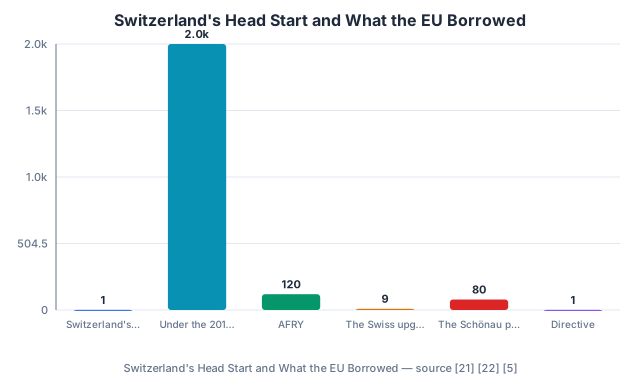
Switzerland’s revised Water Protection Ordinance, requiring micropollutant removal at wastewater treatment plants, came into force on 1 January 2016 [21]. AFRY (formerly Pöyry Schweiz AG), general planner on the retrofit program, states the ordinance covers roughly 120 wastewater treatment plants [22] — a fraction of the scope the recast UWWTD imposes on the EU, where quaternary-treatment obligations apply to plants of 150,000 p.e. and above, plus qualifying plants down to 10,000 p.e. [1][2]. Switzerland’s model funds the upgrades through a national wastewater levy of CHF 9 per resident per year, running until 2034 [22] — a flat public levy, not a producer-pays mechanism. By 2018 the Werdhölzli plant in Zurich was scheduled to complete its retrofit, joining two plants already converted in Dübendorf and Herisau [21]. At the Schönau plant, the chosen method — dosing powdered activated carbon into the wastewater stream followed by tertiary filtration [22] — achieved an average micropollutant elimination rate above 80%, exceeding the legal requirement [22], while avoiding the toxic by-products that processes like ozonation can generate [22]. AFRY also reports that actual PAC dosages needed in operation came in lower than pilot-testing predictions [22], an early signal that this specific chemical-dosing cost can undershoot pilot forecasts.
The recast UWWTD sets the same elimination-rate benchmark Switzerland uses — plants above 150,000 population equivalent must remove at least 80% of targeted micropollutants [9] — but replaces the flat resident levy with extended producer responsibility [5]: pharmaceutical and cosmetics producers now bear 80% of total quaternary treatment costs, investment and operational, plus monitoring and data collection [23][24]. Smaller plants of 10,000–150,000 p.e. face the obligation only where discharge hits sensitive waters [9], and full EU-wide compliance extends to 2045 [9], against projected benefits of €6.6 billion per year for the recast directive as a whole [5] — a timeline Switzerland’s narrower, resident-funded program never had to justify at this scale.
The Collision With Energy-Neutral Treatment
The recast directive asks utilities to do two things that can pull against each other. It requires Member States to make treatment plants energy-neutral and cut greenhouse gas emissions by 2045 [5], while separately mandating quaternary treatment for micropollutant removal, funded through extended producer responsibility on pharmaceutical and cosmetics makers [5]. Industry technical analysis is blunt about the conflict: adding quaternary treatment will inevitably increase plant energy consumption [25]. Advanced removal technologies such as reverse osmosis and electrochemical oxidation compound this — both draw more operational energy and carry embedded carbon from equipment manufacturing [25]. Sources disagree on the deadline: the MBR Site reads the directive’s Table 1 as requiring installations over 10,000 population-equivalent to hit energy neutrality by 2040 [25], versus the 2045 date given on the European Commission’s own summary page for the sector overall [5] — an unresolved discrepancy utilities must clarify before locking in capex plans.
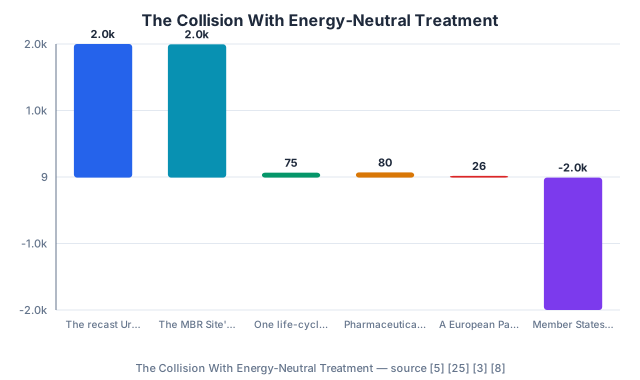
One life-cycle assessment found that supplementary sludge anaerobic digestion combined with solar power can cut CO2-eq emissions from a conventional MLE activated-sludge installation by 75% [25] However, the same analysis concludes utilities and regulators still lack the data to sequence the two mandates, particularly the correlation between whole-life carbon accounting and key plant design parameters [25].
That data gap will matter as the compliance clock runs. Member States must transpose the directive into national law by mid-2027, the point at which national producer-responsibility organizations and fee schedules take legal form [8], with individual producer fees set by the quantity and hazardousness of substances placed on each national market [8]. Producers must cover at least 80% of micropollutant removal costs by 31 December 2028 [3]. A European Parliament plenary debate on 26 March 2026 was expected to raise MEP concerns over EPR cost estimates, proportionality, and knock-on effects for medicine availability and supply security, alongside possible temporary measures [3]. What to watch: whether the Commission resolves the 2040/2045 energy-neutrality discrepancy, whether whole-life carbon accounting gets folded into quaternary-treatment design guidance before the 2027 transposition deadline, and whether the temporary measures floated in March 2026 soften the sequencing pressure on utilities racing to fund and build both mandates at once.
References
- Urban wastewater treatment (from 2027) — EUR-Lex summary — eur-lex.europa.eu — https://eur-lex.europa.eu/EN/legal-content/summary/urban-wastewater-treatment-from-2027.html
- New UWWTD overview presentation (KIT River Basins) — riverbasins.kit.edu — https://www.riverbasins.kit.edu/downloads/29_Kardos_newUWWTD_ORAL_v6_toPDF.pdf
- Urban wastewater treatment rules’ impact on pharmaceutical sector — European Parliament — europarl.europa.eu — https://www.europarl.europa.eu/news/en/agenda/plenary-news/2026-03-25/6/urban-wastewater-treatment-rules-impact-on-pharmaceutical-sector
- The Recast Urban Wastewater Treatment Directive: Financial and Legal Ramifications for the Pharmaceutical and Cosmetics Industries — Stentors.eu — stentors.eu — https://stentors.eu/articles/the-recast-urban-wastewater-treatment-directive-financial-and-legal-ramifications-for-the-pharmaceutical-and-cosmetics-industries
- Urban wastewater — European Commission, DG Environment — environment.ec.europa.eu — https://environment.ec.europa.eu/topics/water/urban-wastewater_en
- Bromate removal in an ozone–granular activated carbon filtration process for organic micropollutants removal from wastewater — ScienceDirect — sciencedirect.com — https://www.sciencedirect.com/science/article/pii/S2214714424001077
- EurEau September 2025 newsletter — eureau.org — https://www.eureau.org/news/1031-eureau-september-2025-newsletter
- Extended Producer Responsibility for Pharmaceutical and Cosmetics Companies: Adoption of the Recast Urban Wastewater Treatment Directive (Baker McKenzie Healthcare & Life Sciences Blog) — healthcarelifesciences.bakermckenzie.com — https://healthcarelifesciences.bakermckenzie.com/2024/12/03/extended-producer-responsibility-for-pharmaceutical-and-cosmetics-companies-adoption-of-the-recast-urban-wastewater-treatment-directive/
- What the recast Urban Waste Water Treatment Directive means for Ireland (Environment Ireland) — environmentireland.ie — https://www.environmentireland.ie/what-the-recast-urban-waste-water-treatment-directive-means-for-ireland/
- New EU Rules Tighten Grip on Pharmaceutical Wastewater Pollution (Southern Scientific Ireland) — southernscientificireland.com — https://southernscientificireland.com/2026/03/12/pharmaceutical-wastewater/
- Call to ’Stop the Clock’ on UWWTD – Urgent reassessment needed to protect competitiveness and supply (EFPIA) — efpia.eu — https://www.efpia.eu/news-events/the-efpia-view/statements-press-releases/call-to-stop-the-clock-on-uwwtd-urgent-reassessment-needed-to-protect-competitiveness-and-supply/
- UWWTD: AESGP expresses concerns over disproportionate and unfair application of Extended Producer Responsibility (AESGP) — aesgp.eu — https://aesgp.eu/articles/uwwtd-aesgp-expresses-concerns-over-disproportionate-and-unfair-application-of-extended-producer-responsibility
- EFPIA begins legal proceedings in European court, to seek clarity on Urban Wastewater Treatment Directive — efpia.eu — https://www.efpia.eu/news-events/the-efpia-view/statements-press-releases/efpia-begins-legal-proceedings-in-european-court-to-seek-clarity-on-urban-wastewater-treatment-directive/
- AESGP: "The General Court’s procedural decision does not resolve the UWWTD’s fundamental flaws" — aesgp.eu — https://aesgp.eu/articles/aesgp-the-general-courts-procedural-decision-does-not-resolve-the-uwwtds-fundamental-flaws
- EFPIA response to the General Court ruling on the Urban Wastewater Treatment Directive — efpia.eu — https://www.efpia.eu/news-events/the-efpia-view/efpia-news/efpia-response-to-the-general-court-ruling-on-the-urban-wastewater-treatment-directive/
- The EPR Obligations of the New Urban Wastewater Treatment Directive: Key Questions and Next Steps for Member States (Covington & Burling) — cov.com — https://www.cov.com/en/news-and-insights/insights/2024/12/the-epr-obligations-of-the-new-urban-wastewater-treatment-directive-key-questions-and-next-steps-for-member-states
- European Commission risks repeating past mistakes in Urban Wastewater Treatment Directive cost study — EFPIA — efpia.eu — https://www.efpia.eu/news-events/the-efpia-view/statements-press-releases/european-commission-risks-repeating-past-mistakes-in-urban-wastewater-treatment-directive-cost-study/
- Environmental Pollution from Pharmaceuticals — PMC (NIH) — pmc.ncbi.nlm.nih.gov — https://pmc.ncbi.nlm.nih.gov/articles/PMC12471260/
- Feasibility of an EPR system for micro-pollutants — Publications Office of the EU — op.europa.eu — https://op.europa.eu/en/publication-detail/-/publication/14249cbc-5f1c-11ed-92ed-01aa75ed71a1/language-en
- Extended Producer Responsibility for Pharmaceutical and Cosmetics Companies: the Recast Urban Wastewater Treatment Directive — Baker McKenzie Healthcare & Life Sciences Blog — healthcarelifesciences.bakermckenzie.com — https://healthcarelifesciences.bakermckenzie.com/2024/05/13/extended-producer-responsibility-for-pharmaceutical-and-cosmetics-companies-the-recast-urban-wastewater-treatment-directive/
- Stepping up wastewater treatment - SWI swissinfo.ch — swissinfo.ch — https://www.swissinfo.ch/eng/pollution---_stepping-up-wastewater-treatment/42465310
- Switzerland - pioneering in micropollutants removal from wastewater | AFRY — afry.com — https://afry.com/en/insight/switzerland-pioneering-in-micropollutants-removal-wastewater
- A Sea Change for Pharma: EU’s Urban Wastewater Treatment Directive and its Cost Implications | Bird & Bird — biotalk.twobirds.com — https://biotalk.twobirds.com/post/102k03h/a-sea-change-for-pharma-eus-urban-wastewater-treatment-directive-and-its-cost-i
- Urban Wastewater Treatment Directive: A Guide for EU Utilities | Cambi — cambi.com — https://www.cambi.com/blog/urban-wastewater-treatment-directive
- UWWTD and the implications of energy neutrality in wastewater treatment - The MBR Site — thembrsite.com — https://www.thembrsite.com/features/uwwtd-energy-neutrality-wastewater-treatment-eu-urban-wastewater-treatment-directive