EPA’s PFAS Rollback Leaves Utilities’ Sunk Capital in Limbo
EPA’s PFAS Rollback Leaves Utilities’ Sunk Capital in Limbo
The 2024 Rule That Rewired Water Utility Capital Plans
Between 4,100 and 6,700 of the nation’s public water systems, serving 83 million to 105 million people, must install new treatment under EPA’s 2024 PFAS drinking-water rule — a compliance population larger than most states [3]. The rule set a Maximum Contaminant Level of 4.0 ppt for PFOA and for PFOS individually, paired with a Maximum Contaminant Level Goal of zero for both, the first enforceable federal limit ever placed on these compounds [1]. It also set individual MCLs of 10 ppt for PFHxS, PFNA, and HFPO-DA (GenX), plus a Hazard Index of 1 governing any mixture of two or more of PFHxS, PFNA, HFPO-DA, and PFBS [1]. Utilities that had spent years treating PFAS as a monitoring problem suddenly faced a treatment mandate with a hard number attached to every relevant compound, not just the two most studied ones. The rule became legally effective on June 25, 2024, starting the regulatory clock that has driven every capital plan since [1]. EPA priced that mandate at $1.63 billion per year, up from the $1.2 billion annual estimate in the 2023 proposal, and put the rule’s total cost above $128 billion, amortized over 82 years [3]. That amortization window is why utilities financed compliance with long-dated bonds rather than rate spikes — and why the spending was never going to be smooth: EPA projected more than $15 billion due in 2029 alone, the year every system’s capital plan was built to clear [3]. EPA has defended that stringency on public-health grounds, projecting the rule will prevent thousands of deaths and tens of thousands of serious PFAS-attributable illnesses once fully implemented [1]. That health finding, not just the cost estimate, is what utilities now must contend with as the compliance timeline itself comes under review.
Picking a Treatment Technology Under Uncertainty
Meeting the MCLs EPA has set isn’t a matter of following one prescribed method. EPA designated granular activated carbon (GAC), anion exchange (AIX), nanofiltration (NF), and reverse osmosis (RO) as Best Available Technologies for the rule without mandating any single one of them, and its own analysis found that 6-10% of the 66,000 public water systems covered by the rule are out of compliance and will need remedial measures [4]. That leaves each utility to weigh cost, water chemistry, and disposal against the specific compounds it needs to remove.
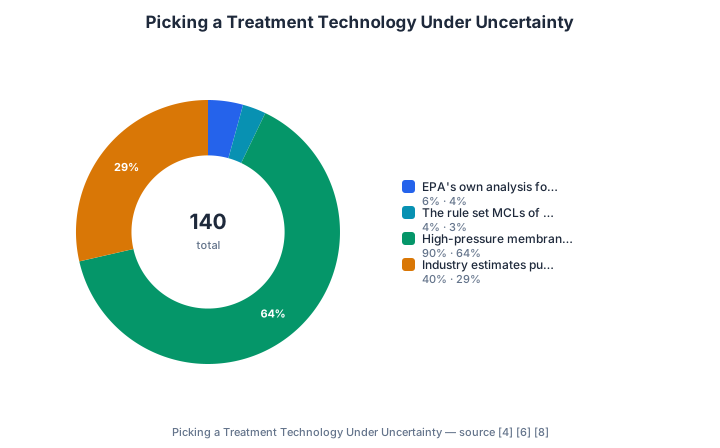
GAC and anion exchange resin remain the industry standards for separating PFAS from water because of the high effluent quality they achieve, but both leave a spent-media disposal problem that current methods only partially solve: landfilling does not destroy PFAS, it only sequesters it for a period, pushing utilities toward reactivation or incineration instead [5]. Anion exchange resin costs more per unit mass than GAC but lasts longer in service and typically removes short-chain PFAS more effectively — why utilities facing high-concentration or short-chain-dominated plumes lean toward it despite the higher unit cost [5]. Short-chain compounds are the technology’s weak point: EPA’s own technical explainer states that GAC works well on long-chain PFAS like PFOA and PFOS, but that shorter-chain compounds such as PFBS and PFBA do not adsorb as well [6]. A utility that installed GAC to hit the PFOA/PFOS limit is not automatically covered for the rest of the rule. High-pressure membranes close that gap: nanofiltration and reverse osmosis remove a wider range of PFAS, including short-chain compounds, at better than 90 percent effectiveness [6]. But those membranes concentrate PFAS rather than destroy it, pushing the contamination into a reject or brine stream that then has to be managed on its own — so choosing membranes over media trades one disposal problem for another [7]. Utilities are weighing GAC, ion exchange, and reverse osmosis against a budget backdrop of an estimated $40 billion to $50 billion in PFAS-related capital costs industry-wide over five years and roughly $1.5 billion a year in ongoing compliance costs [8]. EPA’s proposal to rescind the MCLs for PFHxS, PFNA, GenX, and the Hazard Index covering those compounds — the same compounds GAC handles worst — now threatens to change which of these technologies a given system needs, arriving in the middle of the window utilities have for designing and procuring it [9].
The 2025 Reconsideration and the Sunk-Capital Problem
Utilities that broke ground on granular activated carbon and reverse osmosis trains to hit the rule’s original deadlines are now watching that same rule get renegotiated out from under them.
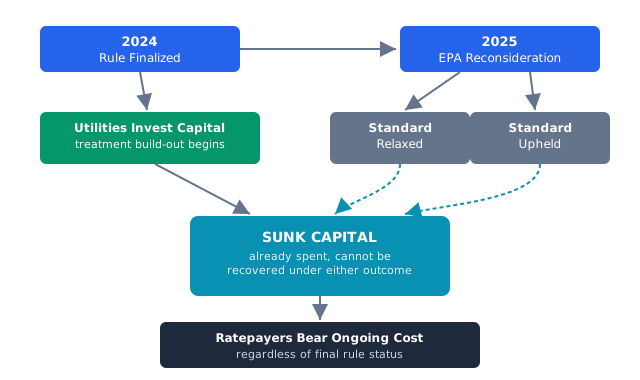
EPA’s 2026 proposal doesn’t touch the underlying limit — it would let systems request and obtain a two-year federal exemption pushing the PFOA/PFOS compliance deadline from 2029 to 2031, while the MCLs stay at 4.0 ppt each and every monitoring and reporting timeline from the 2024 rule stays in force [2]. The extension buys construction time, not regulatory relief: a system testing at or above 12 ppt for PFOA or PFOS must still carry out interim mitigation during the extra two years, so exposure control keeps running on the old clock even as capital spending gets a reprieve [2]. For a utility with a design already procured or a contractor already mobilized, deferring the deadline doesn’t defer the bill — it spreads the same spend over a longer runway and adds financing risk on top.
A companion 2026 proposal reaches further, seeking to rescind the enforceable limits for four of the six regulated PFAS — PFHxS, PFNA, GenX and the Hazard Index mixture covering PFBS — while leaving PFOA and PFOS untouched under the separate extension rule [9]. EPA’s stated basis is procedural rather than toxicological: it argues the Biden EPA folded the regulatory determination and the final rule into a single action, denying the public a comment opportunity the Safe Drinking Water Act requires [9]. A procedural defect can be cured and reissued in a way a health finding cannot, which leaves utilities unable to treat the four-compound rescission as settled even if it eventually succeeds. The rescission proposal’s comment period closed July 20, 2026, so as of this reporting the four-compound limits remain unrescinded and legally binding on paper only [9]. Systems that paused treatment builds on the expectation of relief are now carrying half-finished plant against standards that, for now, still stand.
The Real Cost of Compliance, and Who’s Footing It
Meeting those limits means paying for treatment systems capable of hitting them, and estimates of that price tag diverge sharply depending on who’s doing the counting. EPA’s own regulatory analysis puts the rule’s nationwide compliance cost at $1.5 billion a year, the figure the agency treats as its working benchmark [4]. A water-sector trade association’s competing study more than doubles that figure, projecting $3.8 billion a year in annual costs, landing first on treatment facilities before passing through to the ratepayers those facilities serve [4].
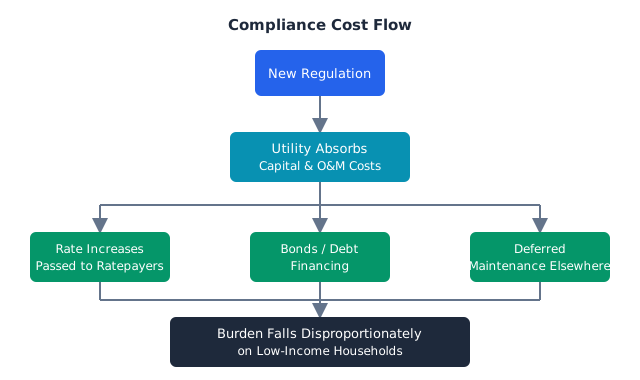
That gap matters less for its size than for where it lands: small systems absorb a disproportionate share of whatever the true cost turns out to be. The same industry study found that per-household compliance costs run from roughly $100 a year in systems serving over one million people to as much as $10,000 a year in systems serving fewer than one hundred [4], a hundredfold spread that reflects the fixed cost of activated-carbon or reverse-osmosis treatment falling across a shrinking customer base as system size drops. A large utility can spread capital costs across hundreds of thousands of bills; a rural system with a few dozen connections cannot, so the same treatment train that barely moves a big-city rate can double or triple a small district’s. EPA projects that six percent to ten percent of the nation’s 66,000 regulated public water systems will need remedial action to meet the new limits [4], and it is disproportionately the small, thinly capitalized ones among them that face the steepest per-household math — the segment least equipped to finance it and most exposed if federal deadlines or funding assumptions shift underneath them.
A State Patchwork That Won’t Wait for Washington
While the federal deadline calendar bends under reconsideration and litigation, state regulators are not waiting for Washington to settle the question.
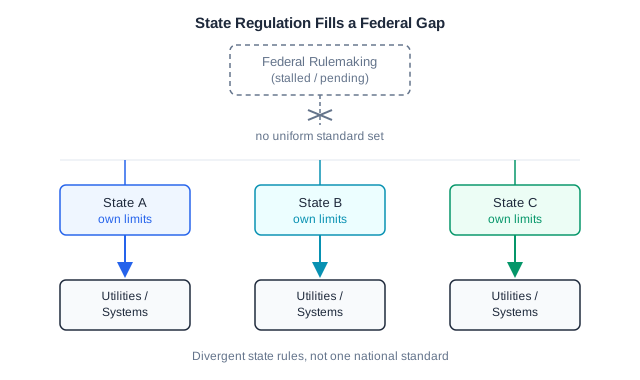
Several states adopted their own PFAS drinking-water standards before EPA finalized its rule, and those state limits don’t automatically soften just because the federal rule is under review. A utility operating in one of these states answers to whichever standard is stricter, and a federal delay or rollback does not relieve it of an existing state-level obligation. This creates a compliance landscape that varies by state line rather than by national rule, so two utilities drawing from the same aquifer but sitting in different states can face materially different testing schedules, treatment triggers and disclosure requirements.
For utility planners, the practical effect is that federal reconsideration cannot be treated as a reason to pause capital planning. A state agency can enforce its own limit on its own timeline, independent of what happens to the EPA rule in court or at the agency itself. Utilities that assumed a federal delay would buy them more time have, in some cases, discovered that their state permit or state drinking-water program never adopted that delay. The safest planning posture treats the federal rule as a floor that could tighten again and the strictest applicable state rule as the binding constraint in the meantime, rather than betting infrastructure timelines on the outcome of Washington’s reconsideration process.
What Utilities Should Watch Next
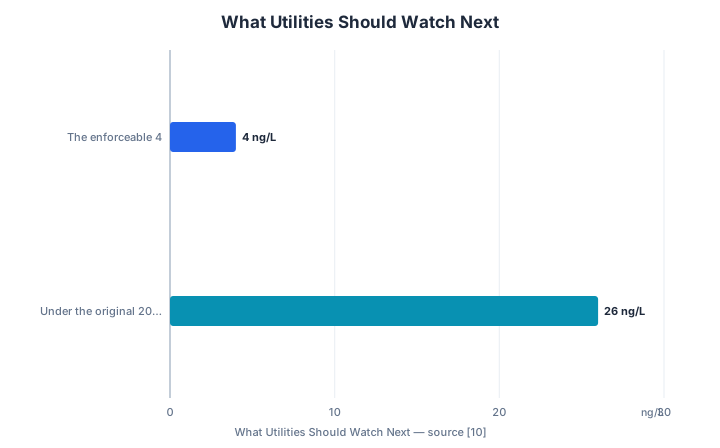
The core tension utilities must track is the gap between what EPA says is safe and what it requires them to achieve: the agency set the MCLG for both PFOA and PFOS at zero [10], reflecting a health assessment that found no safe exposure level, while the enforceable MCL sits at 4.0 ppt [10] — a feasibility-based number tied to current detection and treatment capability rather than to that zero-risk finding. That gap means the rule can tighten further without any new toxicology — if analytical methods or treatment technology improve, EPA has room to lower the enforceable limit toward the health goal it has already declared. Utilities should treat the enforceable limit as a floor that may move, not a permanent target, and build treatment margin rather than designing to the exact number.
The nearer-term question is timing. The original rule set initial monitoring due by April 26, 2027 and capital improvements complete by April 26, 2029 [10], and utilities have been sequencing procurement, financing, and construction against those two dates. Whether the reconsideration and litigation now underway shift either deadline is the single biggest planning variable: a monitoring extension buys utilities time to characterize contamination before committing capital, while a compliance extension changes bond timing, rate-case scheduling, and vendor contracts already in motion. Systems should keep monitoring on schedule regardless of the outcome, since sampling data feeds every downstream decision and cannot be compressed later. They should also watch whether any reconsideration narrows which compounds or systems the rule covers, since a narrower scope would reduce both the population requiring treatment and the aggregate cost utilities and ratepayers must absorb. Until the reconsideration concludes, the prudent course is to keep building toward the original dates while flagging any contract terms that assume no extension.
References
- Environmental Protection Agency (2024) ’PFAS National Primary Drinking Water Regulation’. Federal Register. Available at: https://www.federalregister.gov/documents/2024/04/26/2024-07773/pfas-national-primary-drinking-water-regulation (Accessed: 7 September 2026).
- US Environmental Protection Agency (2026) ’Proposed PFOA and PFOS Compliance Extension Rule’. US EPA. Available at: https://www.epa.gov/sdwa/proposed-pfoa-and-pfos-compliance-extension-rule (Accessed: 7 September 2026).
- Best Best & Krieger LLP (2024) ’U.S. Environmental Protection Agency Finalizes New Drinking Water Regulations for Six PFAS Chemicals’. Best Best & Krieger LLP. Available at: https://bbklaw.com/resources/u-s-environmental-protection-agency-finalizes-new (Accessed: 7 September 2026).
- Phillips, D.R., Almanzar, J.A. and Broughton, M. (2024) ’EPA Finalizes PFAS Drinking Water Regulation’. Holland & Knight. Available at: https://www.hklaw.com/en/insights/publications/2024/04/epa-finalizes-pfas-drinking-water-regulation (Accessed: 7 September 2026).
- Ling, A.L., Stegner, T., Thompson, M., Viswanathan, S., Pinkard, B.R., Wolohan, K.M., Richard, D.E. and Ellis, A. (2025) ’Spent Media Management Pathways for PFAS Treatment Applications’. Water Environment Research, 97(7), e70130. Available at: https://doi.org/10.1002/wer.70130 (Accessed: 7 September 2026).
- US EPA (2018) ’Reducing PFAS in Drinking Water with Treatment Technologies’. Science Matters, US Environmental Protection Agency. Available at: https://www.epa.gov/sciencematters/reducing-pfas-drinking-water-treatment-technologies (Accessed: 7 September 2026).
- DataIntelo (2026) ’PFAS Removal Technologies: Challenges And Innovations In Water Treatment’. Water Online. Available at: https://www.wateronline.com/doc/pfas-removal-technologies-challenges-and-innovations-in-water-treatment-0001 (Accessed: 7 September 2026).
- Crispin, M. and Cossin, A. (2026) ’Water sector evaluates readiness for looming PFAS treatment deadline’. WaterWorld. Available at: https://www.waterworld.com/drinking-water-treatment/pfas/article/55386362/water-sector-evaluates-readiness-for-looming-pfas-treatment-deadline (Accessed: 7 September 2026).
- US EPA (2026) ’Proposed PFAS Rescission Rule’. US Environmental Protection Agency. Available at: https://www.epa.gov/sdwa/proposed-pfas-rescission-rule (Accessed: 7 September 2026).
- US EPA (2024) ’PFAS National Primary Drinking Water Regulation’, Federal Register, 89 FR 32532, 26 April 2024. Available at: https://www.govinfo.gov/content/pkg/FR-2024-04-26/html/2024-07773.htm (Accessed: 7 September 2026).